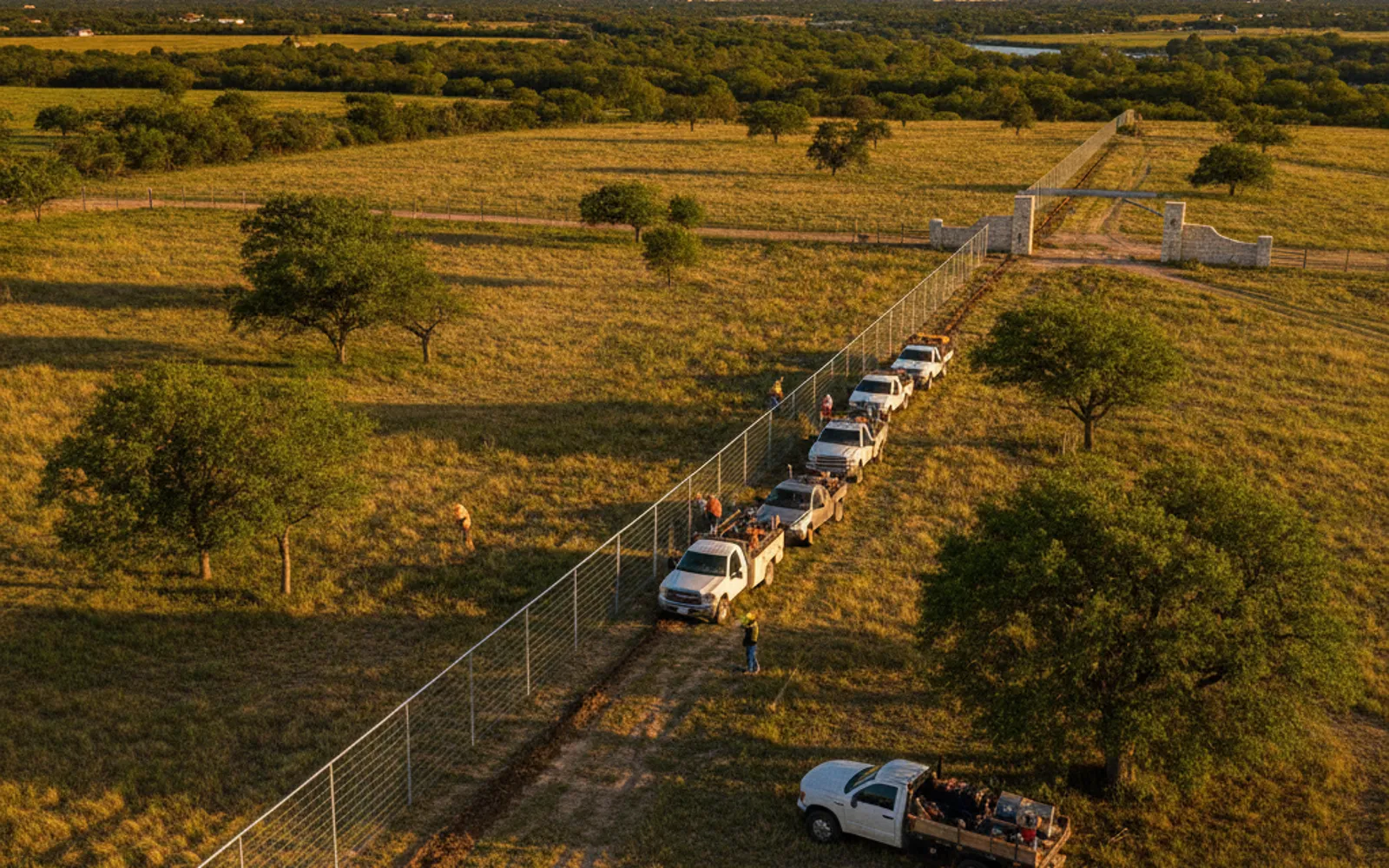
A solar gate opener works well on a ranch gate when three things are true: the gate swings free by hand on plumb posts, the operator is rated for that gate’s real length and weight, and the panel and battery are sized for your worst week of weather, not your best day. Get those right and a solar operator can run a 16-foot pipe gate at the county road for years with no power line in sight. Miss one and it quits the first cloudy week in January.
Most ranch entrances around Waco sit a long way from the meter, and trenching power down a quarter-mile drive costs real money. Solar is the default out here, not the upgrade. What matters is the gate, the posts, the weather and the livestock, in that order.
If you want someone to look at your entrance and tell you straight whether it can carry an operator as it stands, call (254) 870-8898 for a free on-site estimate.
Start with the gate, not the opener
Every opener lists a maximum gate length and a maximum gate weight. Read both. Mighty Mule’s MM571W single swing opener, for example, is rated for gates up to 18 feet or 850 pounds. Treat those as two separate ceilings, not a pair you can hit at once. A long gate puts more leverage on the arm than a short gate of the same weight, so the closer a gate gets to both limits, the harder the motor works. If your gate is near either one, ask the maker or installer before you buy.
Weigh your gate or ask whoever built it. A farm-store tube gate and a welded pipe gate of the same length are not in the same class. A 16-foot gate of heavy-wall pipe with rod or pipe infill can outweigh a tube gate several times over, and the light and medium-duty kits are sized for the tube gate.
That same product page carries a note most people skip: the operator is not for solid-surface gates, only gates with less than 30 percent solid coverage. A plasma-cut steel panel with your brand across it catches wind like a sail. On a gusty spring afternoon that load fights the motor, trips the obstruction sensing and drains the battery. A solid gate needs an operator chosen for it from the start.
The posts carry everything
An operator does not fix a sagging gate. It makes one worse. If the gate drags, binds or has to be lifted to latch, the motor fights that every cycle, draws more current and wears out early. Fix the hang first; our guide to fixing a sagging ranch gate covers the usual causes.
In blackland clay the hinge post is the weak point. Clay swells when wet and shrinks and cracks in a dry August, and a shallow post walks out of plumb over a few seasons. The operator bracket bolts to that post, so when it leans, the arm geometry changes and the gate stops closing square. For an automated entrance the hinge post should be heavy pipe set deep in concrete.
A simple test: unlatch the gate and swing it by hand. It should move with light, even pressure through its whole arc, stay where you leave it and clear the ground everywhere. If it does not, the opener is not your next purchase.
Swing or slide on a ranch driveway
| Setup | Where it fits | What to watch |
|---|---|---|
| Single swing, one operator | Openings up to about 16 feet with a light or medium gate | Flat or falling ground across the swing; arm length and weight limits |
| Dual swing, two operators | Wide openings, say 20 feet as two 10-foot leaves, for trailers and hay trucks | Two arms, two hinge posts, a center stop, more battery per cycle |
| Slide (rolling or cantilever) | Ground rises inside the gate, or no room for a swing | A clear, level run beside the drive at least as long as the opening |
Two things decide it on most ranches. First, grade. A gate that swings uphill into a rising drive hits the ground partway through its arc. A rising hinge or some dirt work can fix that, but sometimes a slide is the honest answer. Second, direction. Swing the gate in, onto your property, so a truck and trailer can pull off the road and wait without the gate coming toward them or toward traffic.
If you are still choosing the gate itself, our ranch entrance gate cost guide walks through gate types.
Sizing solar and battery for a Texas summer and a cloudy week
A solar gate opener is a small off-grid power system. The battery runs the motor and every accessory, day and night, and the panel has to replace what it spends on short winter days, not just in July.
US Automatic’s solar guide for gate openers splits the country into three solar regions with average charge time of 1.5, 3 and 5 hours a day, and recommends a sealed Group U-1 battery, typically 30 to 35 amp-hours. That battery size is about reserve: enough stored power to keep the gate running through a stretch of gray days when the panel makes very little.
Summer is rarely the charging problem here. Design for these:
- A wet, overcast week in winter. Short days, low sun, five days of drizzle. The battery carries the gate through it.
- Shade you did not plan for. A panel behind a cedar or a live oak gets a fraction of its output. The same guide is blunt: partial sun gives partial results. Mount the panel where it sees open sky all day, clear of brush that will grow into it.
- Accessories. Keypads, receivers and phone-entry boxes draw power around the clock. US Automatic notes that accessories not built for solar can need up to 2 hours of sunshine a day to do the same job that solar-friendly versions do on under 5 minutes of sun (on a 6-watt panel). A power-hungry entry box on a small panel is a common reason a solar gate dies in December.
Then count cycles. A weekend place with two trucks might see eight opens and closes on a busy day. A working place with feed deliveries, hands, a vet and a school bus might see forty. Heavier gates and dual gates spend more per cycle.
Heat is the battery’s enemy
In a Texas summer the problem is not charging. It is the battery cooking in a metal box in full sun, and heat shortens the life of a lead-acid battery. Give the control box some afternoon shade if you can, keep the vents clear of mud daubers, and treat the battery as a wear part you replace every few years.
Face the panel south and tilt it up. A fixed tilt near the site’s latitude (about 31.5 degrees at Waco) is a common starting point, and steeper favors winter. Mount it high enough that cattle cannot rub it, and wipe off dust and bird droppings now and then.
Safety sensors and the UL 325 basics
An automatic gate can pin a person or an animal against a post. The US operator standard is UL 325, and parts of it matter even on a private ranch.
Apollo’s summary of UL 325 lists the usage classes. Class I is a residential operator for a residence of one to four single families. Class II covers commercial and general-access sites, including multi-family housing of five or more units. A driveway gate serving your house is Class I. A shared gate on a private road serving five or more households likely falls outside Class I, so ask the installer which class applies.
That summary and DoorKing’s UL 325 page cover the layout rules:
- At least two means of entrapment protection for each area where someone could be trapped, in each direction of travel, and external sensors such as photo eyes and contact edges must be monitored by the operator.
- Keypads and other controls at least 6 feet from the moving gate.
- Pedestrians directed to a separate walk-through gate.
- Warning signs visible from both sides.
On a ranch that means photo eyes across the swing path, a keypad post the driver reaches from the truck window without being near the gate, a walk gate beside the drive for anyone on foot, and no kids riding the gate. Force and reversing settings are set at install and should be rechecked after any change to the gate.
Keypads, remotes and exit sensors
- Remotes for the family trucks and the tractor.
- A keypad for feed and propane deliveries, the vet and the farrier. Give each regular their own code so you can shut one off without changing everyone’s. Mount it at truck-window height, and consider a second, taller keypad if hay trucks come through.
- An exit sensor buried beside the drive inside the gate, which opens the gate as a vehicle drives out. It is built to sense vehicles, but a gate that opens for a truck stays open long enough for stock to walk through behind it.
- Auto-close. Most operators have an adjustable timer. With livestock anywhere near the entrance, use it.
- Emergency access. Ask your local fire department whether they want a way through the gate and how. Settle it before the night they need in.
Cattle, horses and hogs around the operator
A cow will scratch on anything at shoulder height, and an operator arm is exactly that. Horses chew wires. Feral hogs root along the drive and can dig into shallow cable.
- Keep stock off the entrance. The cleanest fix is an entrance livestock never reach: a trap or lane inside the gate, or a cattle guard behind the automated gate, so the gate stops traffic and the guard stops cattle.
- Guard the arm. If cattle can reach the operator, a short pipe guard around the arm and control box keeps them from rubbing it out of adjustment.
- Protect the wire. Run cable from the panel, keypad and exit sensor in conduit, buried deep enough that hogs and a box blade will not find it.
- Think about the open gate. An automatic gate can swing open while heifers stand at the fence waiting for feed. Plan the layout so an open gate does not mean cattle on the road. Stock on a highway is a liability problem on top of a fence problem, as our guide to cattle on road liability in Texas explains.
Lightning, surge and the long wire run
Central Texas thunderstorms are hard on electronics mounted on a steel post in an open field. Solar has one quiet advantage: US Automatic points out that solar charging gives isolation from lightning damage that comes in through the AC power feeding a transformer. No power line to the road means one less path for a surge.
It is not immune. Long wire runs to a keypad pick up surges, and a close strike can still take out a control board. Follow the manufacturer’s grounding instructions, keep wire runs short, and learn where the manual release is before a storm, not during one.
What it costs and when to call
For an automatic operator added to an entrance, our range is $2,500 to $6,000. Where a job lands in that range depends on single or dual gates, gate weight, the access controls you want and how much solar the entrance needs. If the gate or posts need work first, that is entrance work; a full custom ranch entrance runs $5,000 to $25,000 and up. The whole table is on our ranch fence cost page.
A farm-store kit costs a fraction of that, and a handy landowner can get good service from one on a light tube gate, on good posts, with low traffic and no stock near the entrance. It gets riskier with a heavy pipe gate, a wide double gate, a solid panel, a busy entrance or cattle nearby.
We will walk the entrance with you, check the gate and posts, count your traffic and tell you what it takes. Our ranch entrance and gate work covers operators, solar and the gate itself across McLennan, Bosque and Falls counties. Call (254) 870-8898 for a free on-site estimate.
Frequently Asked Questions
Will a solar gate opener work in winter in Central Texas?
Yes, if the battery and panel are sized for it. Winter is the design case: short days, low sun and a week of overcast weather. A battery with enough reserve, commonly a 30 to 35 amp-hour sealed battery, carries the gate through gray stretches, and a panel with open sky all day recovers it. Shade from cedar or oaks and power-hungry accessories are the usual reasons a gate quits in December.
How heavy a gate can a solar opener handle?
It depends on the operator. Farm-store kits run from light-duty units for short tube gates up to larger single-swing units rated for gates up to 18 feet or up to 850 pounds, and commercial operators are built for more. Check both ratings against your real gate, and remember that solid panels add wind load. A heavy welded pipe gate often needs more operator than the box at the feed store.
Can I put an automatic opener on my existing ranch gate?
Often, yes. The gate has to swing freely by hand, clear the ground through its whole arc and hang on plumb, solid posts. If it sags, drags or has to be lifted to latch, fix that first, because an operator will wear itself out fighting it. A gate that swings uphill may need a rising hinge, some dirt work or a slide gate instead.
Do cattle trigger the exit sensor?
Exit sensors are built to sense vehicles, so a cow near the drive should not open the gate the way a truck does. The bigger risk is a gate opened for a vehicle staying open long enough for stock to follow it out. Keep livestock off the entrance with a trap, a lane or a cattle guard, and use the auto-close timer.
What does it cost to add a gate opener to a ranch entrance?
Our range for an operator added to an entrance is $2,500 to $6,000, depending on single or dual gates, gate weight, access controls and solar. Gate or post repairs needed first are priced separately as entrance work. The full table is on our ranch fence cost page.