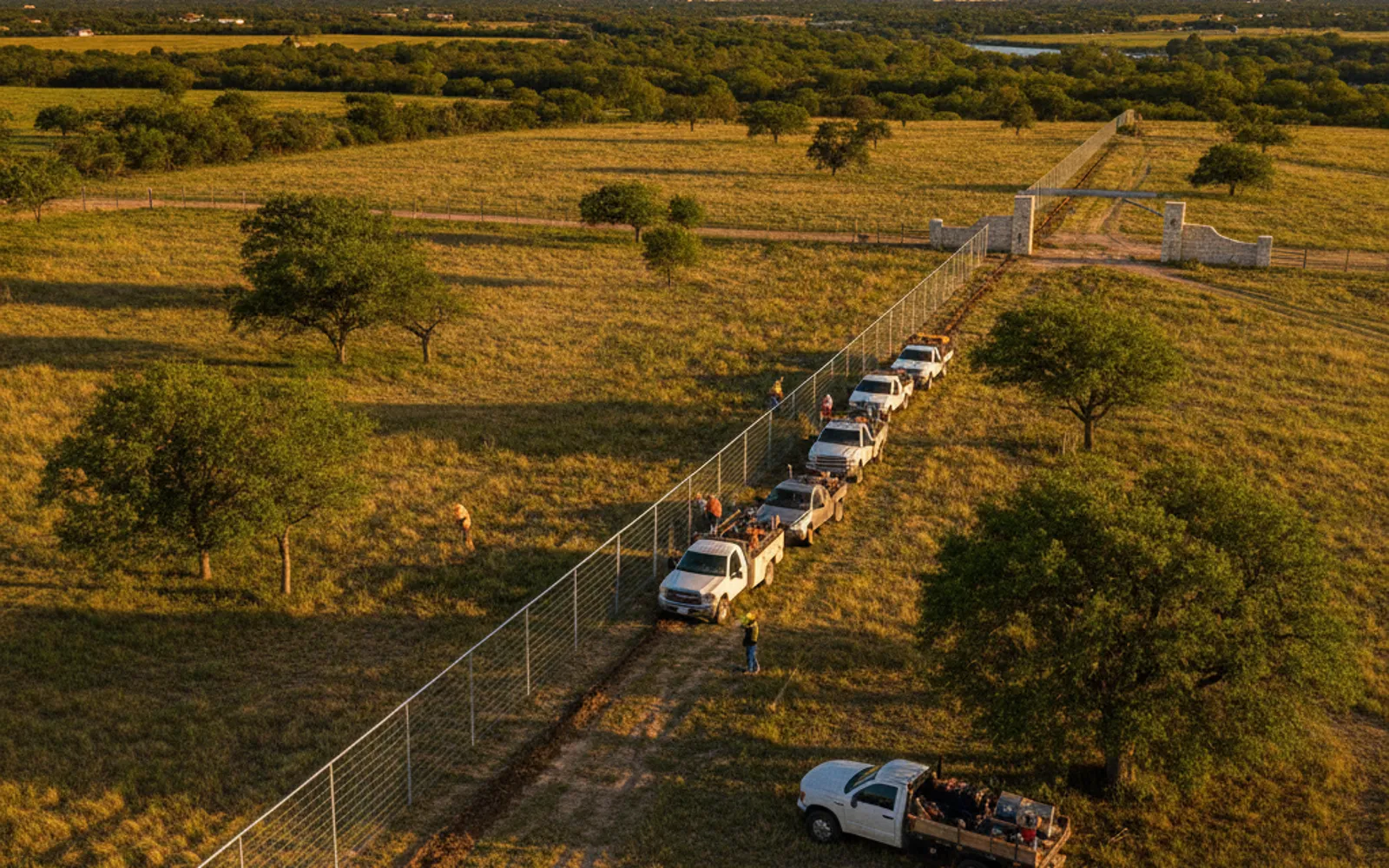
A cattle guard that was set wrong does not fail all at once. One end settles an inch, the rails go out of level, silt packs the pit until it is only six inches deep, and then a loaded gooseneck crosses it on a wet morning and a rail folds. Now you have a truck sitting on a broken guard, an open gate to the county road, and a bill nobody budgeted for.
Installed cattle guard cost in McLennan, Bosque, and Falls counties runs $3,500 to $8,000. Most of that spread has very little to do with the steel. It comes from how wide the opening is, what rating the guard has to carry, how much rock is under the pit, and whether water has anywhere to go once the hole is open.
Below are the parts of the job that actually move the price, plus the sizing and rating decisions worth getting right the first time.
What Drives Cattle Guard Cost
The guard itself is usually the smaller half of the number. Excavation, concrete, wing walls, and tying the whole thing back into the fence line are the rest, and those are the parts that change from one entrance to the next.
Here is what moves a bid up or down on a cattle guard:
- Width across the road. A 10-foot interior crossing and a 20-foot main entrance are different jobs, not the same job at two prices.
- Load rating. A heavier rating means heavier rails, more of them, and a foundation designed to carry the load into undisturbed soil.
- What is under the pit. Blackland clay digs fast. Limestone and caliche mean a hydraulic hammer on the excavator, and that is hours, not minutes.
- Drainage. If the entrance sits low, the pit becomes a stock tank, and a culvert or raised approach adds work before the guard is ever set.
- Foundation type. Poured footings on site versus a precast concrete box changes the equipment, the cure time, and the schedule.
- Wings and fence tie-in. Every guard needs deflector wings and a braced connection to the fence, or stock simply walks around the end of it.
If you want a real figure for your own entrance instead of a range, call (254) 870-8898 and we will come walk it with you. On-site estimates are free, and we would rather look at the ground than guess.
| Width across the road | Where it usually goes | Span driven over | Rating we would set | Where it lands in the $3,500 to $8,000 installed range |
|---|---|---|---|---|
| 10 ft | Interior pasture crossing, ranch pickup and side-by-side only | 8 ft | H-15 | Lower end |
| 12 ft | Standard private drive off a county road | 8 ft | H-20 | Lower to middle |
| 14 ft | Drive that takes goosenecks and feed trucks | 8 ft | H-20 | Middle |
| 16 ft | Main entrance, fire apparatus access, hay equipment | 8 to 10 ft | H-20 or HS-20 | Middle to upper |
| 20 ft and wider | Highway frontage, wide equipment, split-lane entry | 8 to 10 ft | HS-20 | Upper end |
Those bands come off our published ranch fence cost page, which carries the same numbers we quote from the tailgate.
Sizing a Cattle Guard: Span, Width, and the Trucks That Actually Cross It
Two dimensions matter and people mix them up constantly. The span is the distance you drive across, almost always 8 feet on a standard guard and sometimes 10 feet on a heavy one. The width is the dimension across the road, and that is the one you choose: 10, 12, 14, 16, 20, and 24 feet are the common sizes.
Pick the width off the widest thing that will ever cross it, not off your pickup. A dually with a 8-foot-wide gooseneck needs room to swing when it comes off a county road at an angle. A 12-foot guard on a drive that regularly takes a hay truck turns into a place where somebody eventually drops a trailer tire off the wing.
Rail spacing is the other sizing decision, and it is a stock safety issue rather than a cost issue. Around 4 to 5 inches of clear gap between rails is the working range. Wider than that and a calf or a colt can put a foot through and break a leg. Much narrower and cattle figure out they can walk it.
Round pipe rails are part of why a guard works, because a hoof set on a round rail rolls and cattle learn fast that the footing is wrong. Flat-top rails are quieter under a truck but give an animal a flat place to stand, so the spacing has to be right.
Keep a bypass gate beside the guard for moving stock on foot, for a wide implement, and for the day the pit is being cleaned out. It also gives you somewhere to hang the entrance itself, which is covered on our ranch entrance gates page and in our breakdown of ranch entrance gate cost.
Field scenario. A 40-acre cattle place off a county road near Lorena had a 12-foot guard on a drive that took a 30-foot gooseneck twice a week. The wings were bare wire panels, so the cattle had learned to walk the edge of the pit and step around. We pulled it, went to a 14-foot H-20 guard, poured proper footings, and set welded pipe wings tied into an H-brace on each side. That job came to roughly $5,200, which sits in the middle of our $3,500 to $8,000 installed range.
Load Ratings: H-15, H-20, and Why the Sticker Matters
Cattle guard ratings borrow the AASHTO highway loading notation, and the shorthand is simpler than it looks. H-15 describes a design truck around 15 tons. H-20 describes one around 20 tons, which works out to roughly a 16,000-pound wheel load. HS-20 and HS-25 add a trailer axle group to the same design truck, which is what you want under anything that hauls loaded.
Here is the practical version. An interior crossing that never sees more than a ranch pickup and a side-by-side can live at H-15. Anything on a drive that a feed truck, a fuel truck, a concrete truck, a loaded cattle pot, or a fire engine will use should be H-20 at a minimum, and HS-20 if the entrance is your only way in.
Ask your rural fire district what they need before you buy. Some districts will not run apparatus across a guard below a stated rating, and finding that out during a grass fire is the wrong time.
One honest caution. A rating assumes the guard is sitting level on a sound foundation with the load carried into undisturbed bearing soil. Set the same guard on soft backfill or a settled footing and it is no longer performing at its rating, whatever the plate says. If the guard is going into a public road rather than a private drive, expect the county to want a licensed engineer to sign off on the design.
Cattle Guard Installation Cost: What Setting One Really Involves
The install is a dirt-and-concrete job with a steel delivery in the middle, usually two days plus the cure.
Excavate the pit. You want 12 to 18 inches of open air under the rails once the guard is set. Deeper deters stock better and holds more silt before it needs cleaning, but it means more spoil, more concrete, and a harder clean-out later. In the limestone west of the Brazos this is the step that decides your price.
Form and pour the footings. Two continuous footings run under the ends of the guard, sized so the bearing surface reaches undisturbed ground rather than backfill. Precast boxes skip the forming, but they need a machine that can set them and an approach a truck can reach.
Set the guard and tie in the wings. The guard goes on the cured footings, level in both directions and flush with the finished drive. Wings, either pipe panels or poured wing walls, flare from each end back to the fence so stock cannot step around the pit, and they get braced into the fence line the same way any corner does.
Backfill, grade, and wait. Compacted backfill on both approaches keeps the guard from becoming a step. Concrete should have about 7 days before heavy traffic and reaches full design strength near 28 days, so plan another way in for the first week.
Field scenario. A limestone hill section near Valley Mills needed a 16-foot guard at the top of the drive where the caliche starts about eight inches down. Every bit of that pit came out with a hydraulic hammer, and the spoil had to be hauled off instead of spread. Same guard, same concrete, but the excavation ran nearly a full extra day and the job landed around $7,400, near the top of the installed range. That is what rock does, and it is why we do not quote a guard over the phone.
As a general materials-only estimate, a bare 8-by-12-foot H-20 steel guard runs somewhere around $1,600 to $2,800 and weighs enough that you are not setting it with a tractor loader. That is not our quote. It moves with steel pricing and freight, and it does not include a shovel of the work above.
Ready for a number on your own entrance? Call (254) 870-8898 or ask for a free on-site estimate and we will walk the drive, check the drainage, and put it in writing.
What a Cattle Guard Will Not Hold
A cattle guard is a cattle tool. It is good at cattle and roughly nothing else.
Sheep and goats cross guards. Their feet are small enough to find purchase and they are patient enough to work it out, so if you run small stock you need a gate, not a guard. Our post on fencing for goats and sheep covers what does hold them.
Horses are unpredictable. Most respect a guard, some walk them once they have watched a horse do it, and a spooked horse crossing a guard is how you get a shattered cannon bone. On a horse place we would rather hang a good gate than trust a pit.
Deer step over or jump one entirely, so a guard does nothing for a high-fenced operation. Hogs go under the wings if the wings are not tight to the ground, and a loose wing is exactly the sort of gap feral hogs work on until it is a hole.
Painted guards, meaning stripes on concrete with no pit, are not a substitute. They work on some cattle for some period of time, and then one animal tests it and the whole herd learns. If the consequence of a failure is stock on a county road, do not build the version that depends on cattle staying fooled.
Field scenario. A 300-acre cattle lease west of Crawford wanted three interior crossings so the hand could run the loop without opening gates. All three were pickup-and-side-by-side traffic only, on dirt, with no drainage problem and easy digging. Those went in as 12-foot H-15 guards on poured footings and each landed near the bottom of the range, around $3,900. The main entrance off the county road on that same place was a different animal and got a 16-foot H-20.
County Roads, Right-of-Way, and Texas Stock Law
If the guard sits entirely on your own drive, past the right-of-way line, it is your business. If any part of it sits in a county road right-of-way, or you are proposing to put a guard across the county road itself, that is the commissioners court’s call. County authority over roads and bridges sits in Texas Transportation Code Chapter 251, and every county handles requests a little differently. Call the precinct commissioner’s office before you dig.
An entrance off a state highway is a TxDOT access matter and needs a permit for the driveway itself, not just the guard. That process takes longer than the install does, so start it early.
Worth knowing the background too. Whether your stock is required to be fenced in, and what happens when they get out, comes from local stock law rather than a single statewide rule. The fence and range provisions live in Texas Agriculture Code Chapter 143, and the practical county-by-county picture is in our guide to Texas stock law by county. A guard that stops working turns into a liability question.
Frequently Asked Questions
How much does a cattle guard cost installed in Central Texas?
Installed cattle guard cost in McLennan, Bosque, and Falls counties runs $3,500 to $8,000. Width, load rating, digging conditions, and drainage decide where in that band your entrance lands. Rock is the biggest variable, which is why we look at the site rather than price over the phone.
What size cattle guard do I need?
Standard widths are 10, 12, 14, 16, 20, and 24 feet across the road, with an 8-foot span in the direction of travel. Size it off the widest vehicle that will ever use the drive, not your pickup, and give yourself room for a trailer swinging in off a county road. Twelve feet handles most private drives, and 14 to 16 feet is the safer choice if goosenecks, hay equipment, or fire apparatus come through.
Will a cattle guard hold horses, goats, or sheep?
Not reliably. Goats and sheep cross guards routinely, and horses vary from animal to animal with real injury risk if one tries to cross and slips. Guards are a cattle tool, and for anything else you want a gate.
How often does a cattle guard need cleaning out?
Every two to five years for most places, sooner on a drive that washes silt into the pit. Once the open depth under the rails drops below about a foot, the guard stops reading as a hazard and cattle will start walking it. Cleaning is a backhoe and an hour, which beats replacing a guard that has been carrying loads on packed fill.