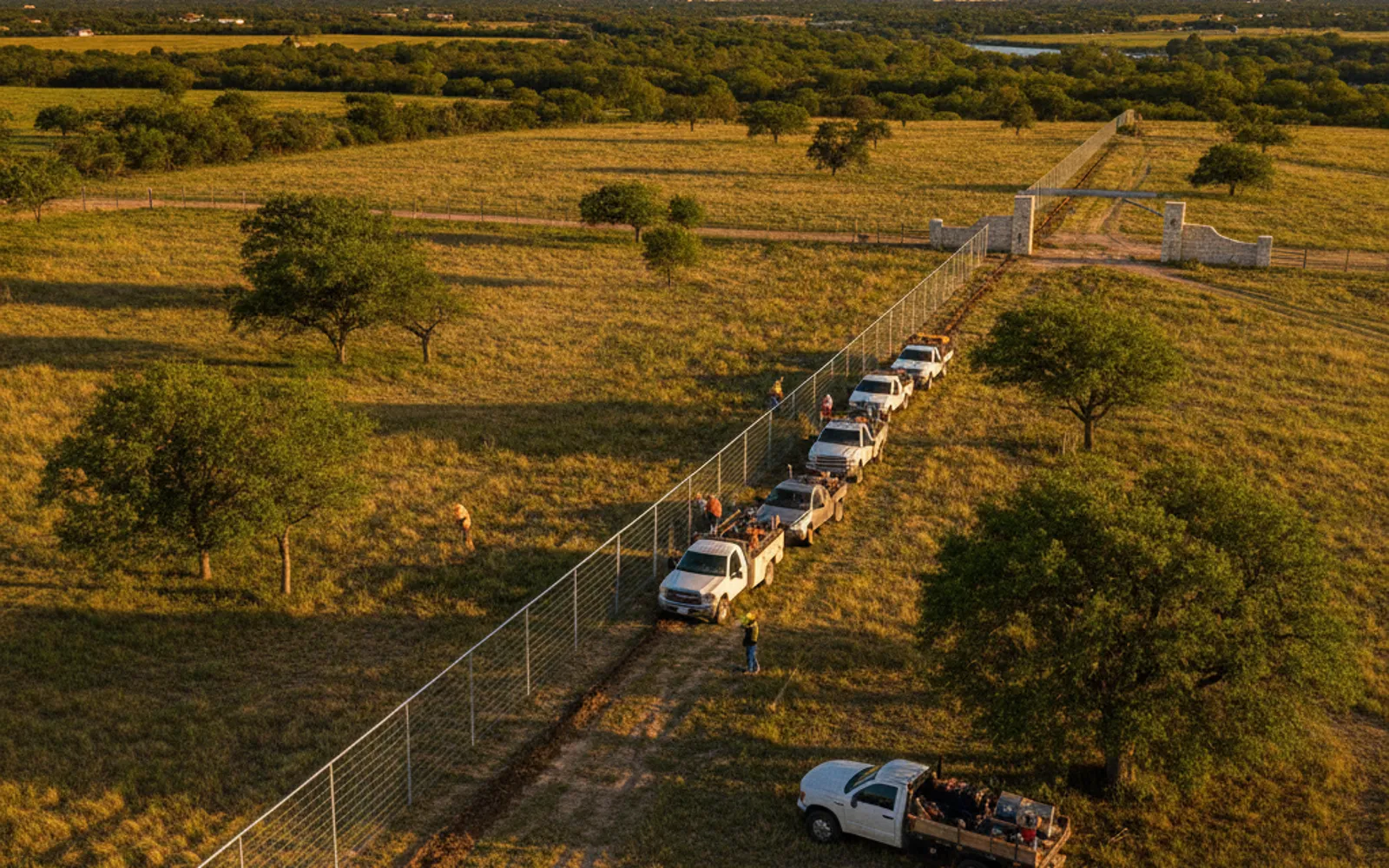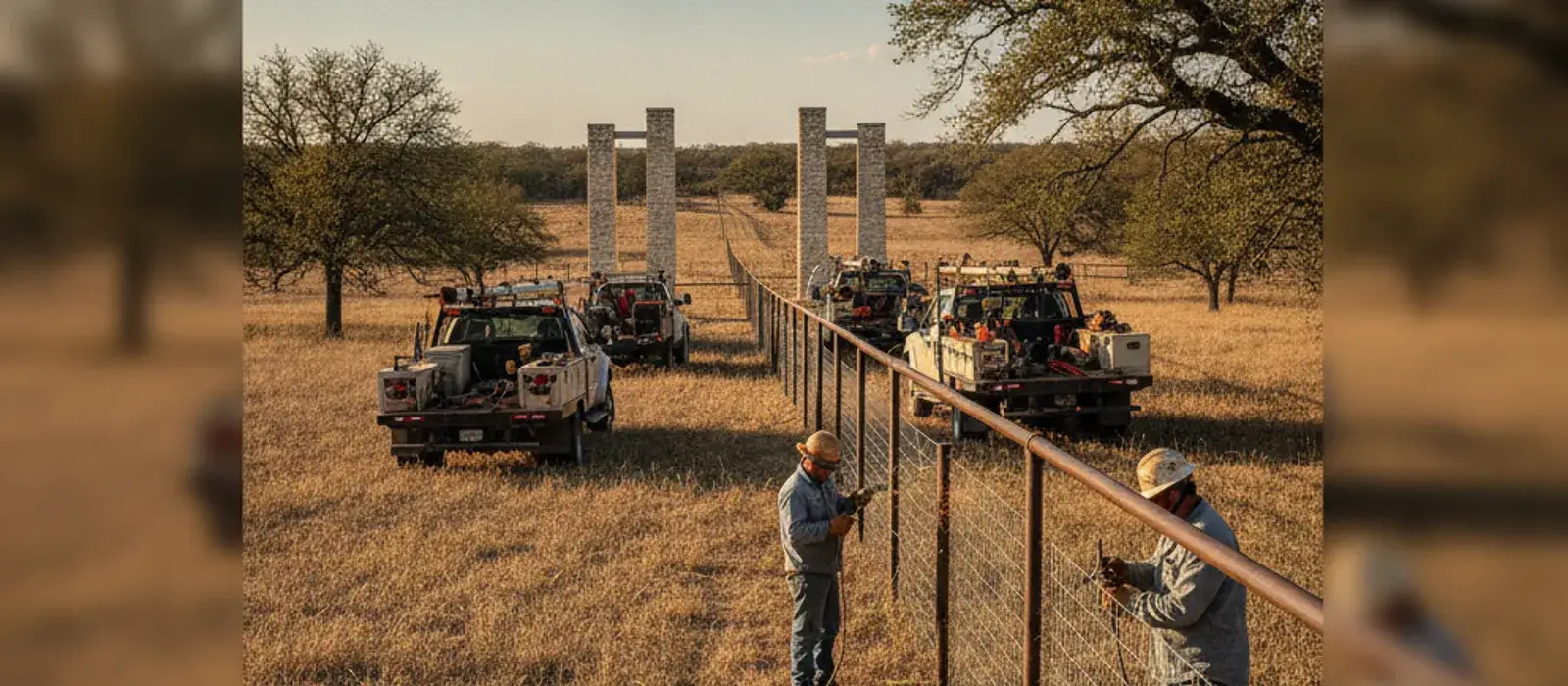
A good crew can roll out a quarter mile of barbed wire in a single day. So why did your neighbor’s fence take six weeks from handshake to last staple?
If you’re asking how long does it take to build a fence, the honest answer is that the building is the fast part. On most ranch jobs around Waco, the actual construction takes days. The waiting, the scheduling, the material orders, and the weather take weeks. This article walks through real timelines from jobs we’ve run in McLennan, Bosque, and Falls counties, so you can plan calving season, a land closing, or a hunting lease around actual dates instead of guesses.
How long does it take to build a fence? The short answer
Here’s the rule of thumb we give folks on the phone. A three man crew building 5 strand barbed wire on decent ground covers about 1,000 to 1,500 feet per day once posts are set. Post setting runs slower, roughly 60 to 100 wood posts a day with an auger, faster with T-posts.
Put it all together and typical ranch jobs shake out like this:
- A quarter mile of barbed wire cross fence: 2 to 4 working days.
- Ten acres fully perimeter fenced (about 2,640 feet): 4 to 7 working days.
- A full mile of new perimeter fence: 2 to 3 weeks.
- A mile of 8 foot game fence: 3 to 5 weeks.
Those are construction days. Add 1 to 3 weeks of lead time before a crew shows up, longer in spring when everybody in Central Texas wants a fence at once.
If you’re trying to hit a hard date, a cattle delivery or a closing on land, call us early. We’ll walk the line, give you a free written estimate, and put a real start date on paper. Reach us at (254) 870-8898 or through our contact page.
What eats up the calendar before the first post goes in
Most of a fence timeline happens before anyone digs a hole. Here’s where the days go.
The estimate and the walk. A contractor should walk your line in person, not quote off an aerial photo. That visit usually happens within a few days of your call. The written quote follows in another day or two.
Property lines. If you’re not sure where your line sits, get a survey before the fence goes up. A survey can take 2 to 4 weeks to schedule in our area, and it’s a lot cheaper than moving a fence later. Texas boundary disputes get ugly fast, and a fence built two feet onto the neighbor’s place is a problem you’ll own for years.
Materials. Standard barbed wire, T-posts, and treated pine posts are usually in stock locally. Specialty items are not. Fixed knot game wire, custom entrance gates, and oilfield pipe in specific sizes can take 1 to 3 weeks to land. Pipe prices also move around, so a quote older than 30 days may need updating.
Brush and old fence. A fence line choked with mesquite and cedar has to be cleared before construction starts. Clearing a heavily grown mile can take 2 to 5 days with a skid steer. Tearing out old wire and rotten posts adds another day or two per mile.
Weather. Rain doesn’t just stop work on the wet day. Black clay ground around Waco stays too soft for trucks and augers for 2 or 3 days after a good soak. A wet spring can push a two week job into a month, and no honest contractor can promise otherwise.
Fence installation time by fence type
Different fences move at very different speeds. Wire goes up fast. Welded pipe does not. Here’s what we typically see per crew on ground that’s not solid rock:
| Fence type | Typical production per day | Quarter mile (1,320 ft) | Full mile (5,280 ft) |
|---|---|---|---|
| 5 strand barbed wire, T-posts | 1,000 to 1,500 ft | 2 to 3 days | 7 to 10 days |
| Barbed wire, wood posts | 700 to 1,000 ft | 3 to 4 days | 10 to 14 days |
| Net wire (field fence) | 500 to 800 ft | 3 to 5 days | 12 to 16 days |
| 8 ft fixed knot game fence | 400 to 600 ft | 4 to 6 days | 15 to 25 days |
| Welded pipe fence | 150 to 300 ft | 5 to 9 days | 20 to 35 days |
| Pipe entrance with gate | n/a | 2 to 4 days | n/a |
Those numbers assume the corners are already in. H-braces and corner assemblies are their own line item. A proper H-brace takes an hour or two to build, and concrete set corners need 24 to 48 hours of cure time before you can stretch wire off them. Skipping that cure time is how fences end up leaning in year one. We covered the details in our post on H-brace fence corners.
Rock changes everything. Ground west of the Bosque River around Crawford and Valley Mills hides limestone shelf a foot down. When the auger hits rock, production can drop by half, and sometimes we switch to a rock drill or pound pilot holes. If your place has shallow rock, budget extra days and read our piece on setting fence posts in rocky ground before you panic at the quote.
A real job, day by day: 4,200 feet near West
Danny Kolar runs cows on 60 acres off Tokio Road outside West. Last fall he called us on a Tuesday because his east line fence was 40 years old and his heifers had figured that out. Here’s how his job actually went.
Day 1 after the call, we walked the line with him and measured 4,200 feet. Two days later he had a written quote: $12,600 for 5 strand barbed wire on T-posts with wood line posts every 100 feet, four new H-brace corners, and one 14 foot gate. He signed that Friday.
Materials were stock items, so we scheduled him 12 days out. Construction went like this:
- Day 1: Tear out old wire, clear brush at the south corner, set corner posts in concrete.
- Day 2: Corners curing, so the crew drove T-posts and set wood line posts.
- Day 3: More posts, hung the gate, hit a rock shelf near the creek and lost half a day.
- Day 4: Stretched and tied all five strands.
- Day 5: Half day of cleanup, clips, and a final walk with Danny.
Call to finished fence: just under three weeks. Actual construction: four and a half days. That ratio is normal, and it’s why the smart move is booking the crew before the old fence fails completely. If your fence is already down and cattle are on the road, that’s a different conversation. We run a 24/7 emergency line for exactly that at (254) 870-8898.
How long does it take to fence 10 acres or a full mile?
Ten acres is the most common request we get from folks buying small places around Lorena, China Spring, and McGregor. A square 10 acres needs about 2,640 feet of fence. In barbed wire, that’s 4 to 6 working days. In net wire it runs closer to a week, because net wire is slower to stretch and usually gets a barbed strand on top.
Carla Mendez bought 10 acres south of Lorena in March for a goat operation. Goats laugh at barbed wire, so she needed net wire all the way around plus two gates. Her quote came in at $23,400. We ordered wire on a Monday, started the next week, and then it rained four inches. The black clay on her place wouldn’t hold a truck for three days. Total construction time was six working days spread across two and a half weeks. The fence didn’t care about the delay. Her closing date did, which is why we’d quoted the job with weather margin built in.
A full mile is a different animal. The Braun family put a mile of 8 foot game fence on their Bosque County place near Valley Mills ahead of deer season. Game fence uses taller posts, deeper holes, and 20 foot rolls of fixed knot wire that fight you on hills. Their job ran $52,800 and took 19 working days across four calendar weeks, including two days lost to rock and one to rain. They signed in July and were done in early September, with time to spare before the season opener. If they’d called in September, they’d have hunted next to a construction site.
Costs scale with distance and terrain, and the per foot math matters more than the total. Our ranch fence cost guide breaks down current per foot pricing, and the post on what it costs to fence 10 acres runs the numbers for small places specifically.
What you can do to keep your fence job on schedule
You control more of the timeline than you might think. A few things that save real days:
Mark your line before the estimate. Flag the corners and know where the property pins are. If you can’t find them, start the survey process now, not after you’ve signed a fence contract.
Clear what you can. If you own a tractor with a shredder, knocking down light brush along the line ahead of time can shave a day or two off the job and a few hundred dollars off the bill. Leave the big mesquite and the old wire tangles to the crew.
Decide on gates early. Gate locations, widths, and swing direction sound like small details until the crew is standing there waiting on an answer. A 16 foot gate handles most trucks and trailers. Equipment like combines may need 20 feet.
Ask about crew scheduling honestly. Any contractor juggling jobs will have a queue. What matters is whether they’ll commit to a window in writing and tell you when weather pushes it. The USDA Natural Resources Conservation Service publishes fencing standards that good contractors build to, and you can read their conservation practice specs at nrcs.usda.gov if you want to know what a spec built fence looks like on paper.
Handle the utility check. In Texas, call 811 before any digging. Locates are free and usually done within two business days. A cut phone line or gas service will stop a job cold and cost far more than the wait.
When to stop doing it yourself and call a crew
Plenty of ranchers can build fence, and a short stretch of repair is a fine weekend project. But the math shifts on bigger jobs. A landowner working weekends might set and stretch 200 to 300 feet a day. At that pace, a mile of fence is 20 or more weekends, most of a year of Saturdays. A crew does it in two to three weeks because they have an auger on a skid steer, hydraulic post drivers, and wire stretchers that cost more than most folks want to spend for one project.
There are also jobs where DIY goes wrong in expensive ways. Corner braces that aren’t built right will let the whole fence sag inside two years. Stretching high tensile game wire without the right equipment can hurt you; that wire stores a lot of energy and does not forgive mistakes. And post holes near buried utilities are not a place to guess. The University of Georgia Extension’s fencing guide, Fences for the Farm, is a solid free read on brace construction and wire handling if you want to see what proper technique involves before deciding.
Our general advice: repairs and short runs, do them yourself and take pride in it. Full perimeters, game fence, pipe fence, and anything on rock or near utilities, hire it out. Your time is worth something, and a professionally built barbed wire fence around here should give you 30 plus years before it needs real attention.
Ready to put a date on the calendar? Request a free written estimate through our contact page or call (254) 870-8898. We’ll walk your line, quote it in writing, and tell you honestly when we can start.
Frequently Asked Questions
How long does it take to build a fence around 10 acres?
Plan on 4 to 7 working days of construction for a square 10 acre perimeter, which is about 2,640 feet of fence. Barbed wire lands at the fast end and net wire at the slow end. Add 1 to 3 weeks of lead time for scheduling and materials, so the full timeline from first call to finished fence usually runs 3 to 5 weeks.
Can a fence be built in one day?
Short runs, yes. A crew can tear out and rebuild a few hundred feet of storm damaged fence in a day, and we do exactly that on emergency calls when cattle are getting out. Anything involving concrete set corner posts needs at least a second day, because concrete has to cure before wire gets stretched off it.
How far in advance should I schedule a fence contractor?
Call 4 to 6 weeks ahead for normal jobs, and 2 to 3 months ahead if you need work done in spring or right before deer season. Those are the busiest windows in Central Texas. Emergency repairs are the exception; a broken fence with livestock out gets same day attention.
Does rain really delay fence work that much?
Yes, and it’s mostly about the ground, not the rain itself. The black clay soil common around Waco stays too soft to support trucks and augers for 2 to 3 days after a heavy rain, and holes augered in saturated clay don’t hold posts well. A contractor who works through that is trading your fence quality for their schedule.