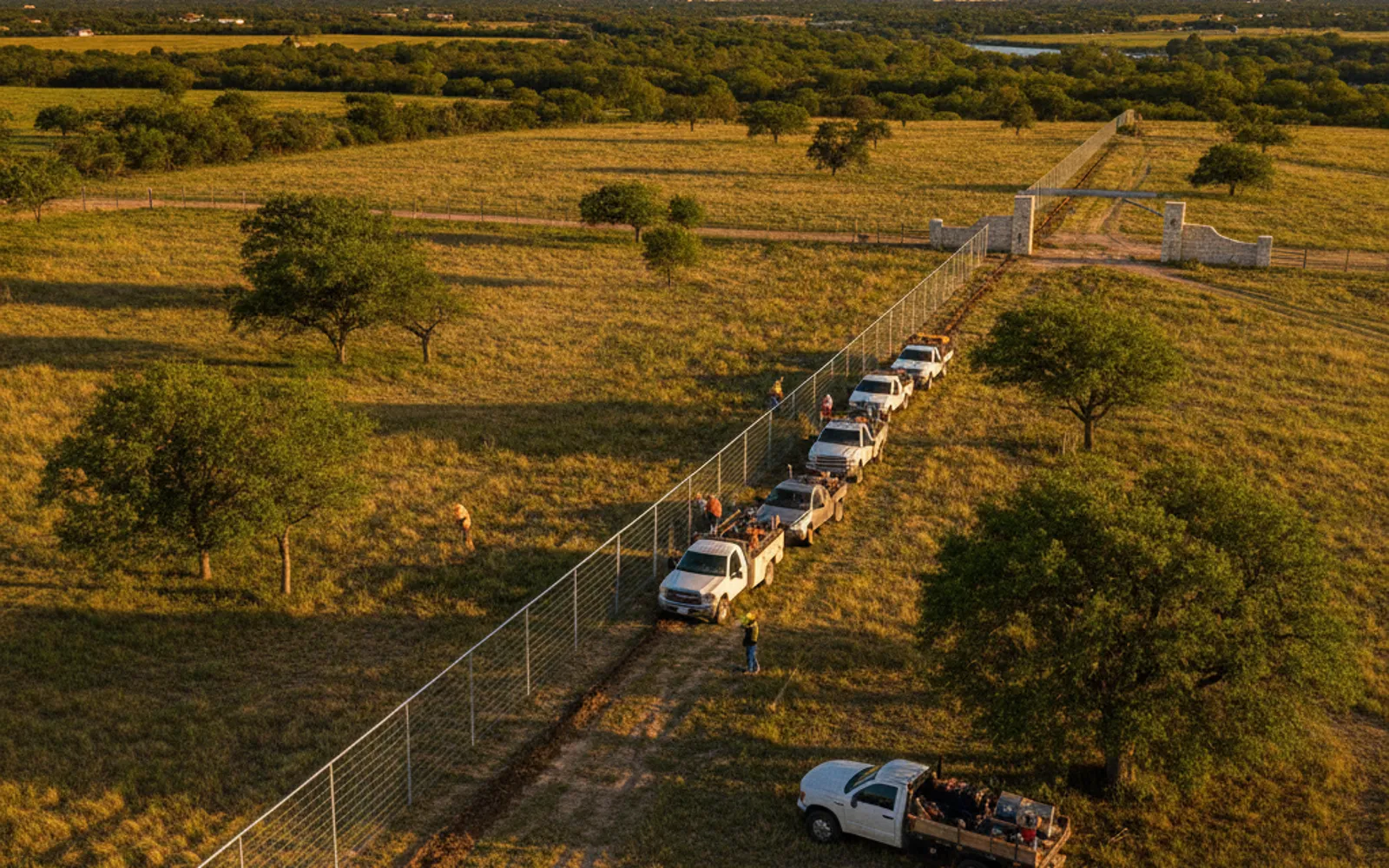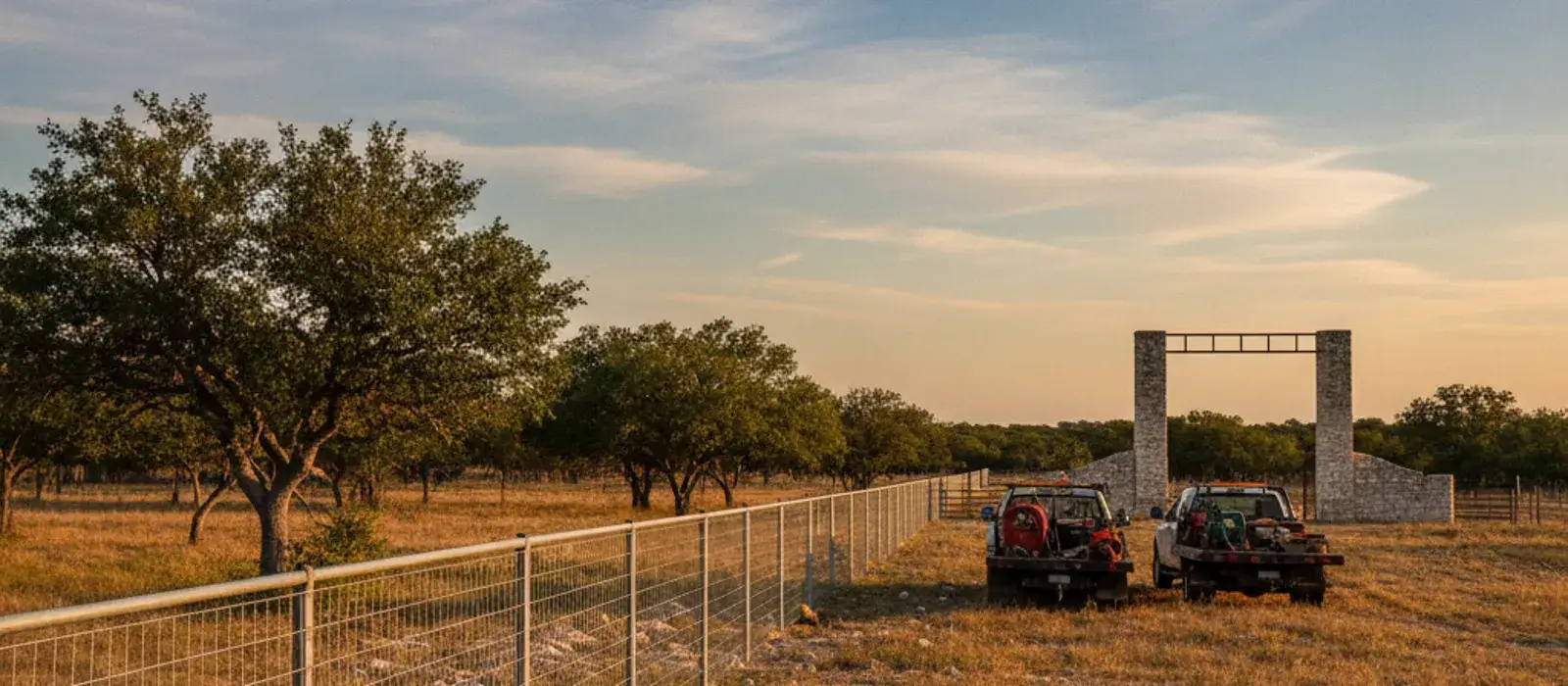
There’s a fence off FM 185 near Crawford that’s been holding cattle since the 1960s, and two pastures over there’s one built in 2016 that’s already sagging into the grass. Same county, same weather, same cows. So how long does a barbed wire fence last? The honest answer is 20 to 50 years, and the gap between those two numbers comes down to what wire you bought, what posts you set, and how the fence was built in the first place.
We build and repair barbed wire fence all over McLennan, Bosque, and Falls counties, so we’ve seen fences at every age from brand new to older than the rancher who owns them. This article walks through the real lifespan numbers, the things that quietly kill a fence early, and how to tell whether yours is worth patching or ready for the dozer pile.
The Short Answer: 20 to 50 Years, Depending on What’s in the Ground
A barbed wire fence isn’t one thing. It’s wire, posts, braces, and staples, and each part ages on its own clock.
The wire itself is usually the longest-lived part. Good galvanized barbed wire in a dry climate can stay serviceable for 40 to 50 years. The posts are the weak link. Untreated or poorly treated wood posts can rot out in 10 to 15 years, and once posts go, the whole fence goes with them, no matter how good the wire still looks.
Here’s how the pieces typically hold up in Central Texas conditions:
| Component | Typical Lifespan | What Usually Kills It |
|---|---|---|
| Class 1 galvanized wire | 15-25 years | Thin zinc coating rusts through |
| Class 3 galvanized wire | 40-50 years | Barb damage, stretching, hog impacts |
| Untreated wood posts | 5-15 years | Ground-line rot, termites |
| Treated pine posts | 20-30 years | Rot at the ground line, cattle pressure |
| Cedar heart posts | 25-40 years | Slow rot, splitting with age |
| Steel T-posts | 25-35 years | Rust at the soil line, bending |
| Pipe corners and H-braces | 40+ years | Almost nothing if set right |
Notice that spread on wire. Class 1 galvanizing carries roughly a third of the zinc that Class 3 does, and in our humidity that difference shows up as rust streaks within a decade. We wrote a whole piece on why Class 3 galvanized wire is worth the extra cost if you want the details.
If your fence is showing its age and you’d rather have a professional eye on it, request a free written estimate or call us at (254) 870-8898. We’ll tell you straight whether it needs a repair crew or a rebuild.
What Determines How Long a Barbed Wire Fence Lasts
Four things decide whether your fence dies at 20 or cruises past 50. None of them are luck.
Wire quality. As the table shows, the galvanizing class matters more than the brand name on the spool. Class 3 wire costs maybe 15 to 20 percent more per roll and roughly doubles the wire’s life. That’s the cheapest longevity you can buy on a fence.
Post material and setting. Posts fail from the ground down. A treated pine post set in concrete that traps water can rot faster than a bare post in well-drained soil. Cedar heart posts and steel T-posts shrug off most of what our clay throws at them. If you’re weighing options, our cedar vs treated pine comparison breaks down the real-world numbers.
Bracing and tension. A fence is only as strong as its corners. Weak corner assemblies let the wire slacken, slack wire lets cattle lean, and leaning cattle destroy fences years ahead of schedule. Proper H-braces at corners and pulls are what let a fence hold tension for decades.
Soil and drainage. Blackland clay holds moisture against posts through every wet winter. Sandy or rocky ground drains fast and posts last noticeably longer. Same materials, different dirt, different lifespan.
Land-grant universities that study fencing economics figure barbed wire fence depreciation over roughly a 25 year useful life, which lines up with what we see when average materials meet average maintenance. Oklahoma State University’s fence cost fact sheet is a good outside reference if you want to see how the accountants look at it. Build better than average and maintain it, and you’ll beat that number by a wide margin.
What Shortens a Barbed Wire Fence’s Life in Central Texas
Now for the killers. These are the things we find over and over when a fence dies young around Waco.
Post rot at the ground line. This is cause of death number one. The wood right at the soil surface stays wet, dries, and stays wet again, and that cycle feeds decay fast. By the time a post wiggles by hand, the underground half is usually mush. Our guide on spotting and fixing fence post rot shows you what to look for before it spreads.
Cattle pressure. Cows scratching, leaning, and reaching through for the grass on the other side put hundreds of pounds of sideways force on wire and posts. A fence line next to a heavily stocked pasture ages twice as fast as one along an empty hayfield. Slack strands make it worse, because cattle learn quick that a loose fence is a suggestion.
Feral hogs. Hogs don’t lean on a fence, they hit it. A sounder rooting under the bottom strand will stretch and snap wire, pop staples, and shove posts out of line in one night. Repeated hog traffic can take a decade off a fence’s life along a creek bottom.
Fire, floods, and falling limbs. Grass fires cook the temper out of wire even when it looks fine afterward. Flood debris in water gaps drags whole sections down. And every mesquite or hackberry growing in the fence line is a future limb across your top strand.
Cheap wire and skipped maintenance. Class 1 wire in our humidity, staples driven too tight so the wire can’t move, no tension checks for years at a time. None of these kills a fence overnight. All of them together take 20 years off its life.
Here’s a real example. Doyle Krizan runs about 60 pairs outside Valley Mills, and he called us after hogs tore up the same creek crossing three times in one spring. The fence was 1980s wire on posts that were already soft, so every hog hit snapped strands instead of flexing. Patching it each time was running him around $600 a visit. We rebuilt 900 feet of the creek-bottom stretch with Class 3 wire, steel posts, and a proper water gap for about $4,100, and he hasn’t had a cow out through that bottom since.
Repair or Replace: How to Read an Aging Fence
Somewhere around year 25 to 30, most barbed wire fences hit a fork in the road. Here’s how we call it.
Repair it when the problems are local. A few broken strands, one leaning corner, a stretch of slack wire after a wet winter. If 80 percent of the posts are solid when you push on them, the fence has years left and repairs are money well spent. Most strand splices and re-tensioning jobs run $2 to $4 per foot on the affected sections.
Replace it when the problems are everywhere. If you can rock every third post, if the wire snaps when you try to re-tension it, or if you’re patching the same line every few months, you’ve crossed into throwing good money after bad. Brittle, rusted-through wire can’t hold a splice, and there’s no fixing that. Our rusted barbed wire repair or replace guide has a simple test you can do with a pair of pliers.
The quick field check takes ten minutes. Walk a 200 foot stretch and push hard on every post. Grab a strand mid-span and pull. Look at the wire where it crosses the staples, because that’s where rust bites first. Count what fails. A few failures means repair. Failures every span means replacement.
One caution on the DIY side: re-tensioning old wire is the job that sends people to the emergency room. Brittle wire under a stretcher can snap and whip, and a loaded strand carries real force. Splicing a single break with gloves and eye protection is fine. Re-stretching whole spans of 30 year old wire, pulling H-braces, or rebuilding corners is work for a crew with the right tools. When a job crosses that line, call a professional rather than gambling with a wire stretcher.
Marcy Halbert learned the repair-versus-replace math the practical way. She and her husband bought 42 acres near West in 2024 with a fence the seller called “solid.” First winter, cattle were out on the county road twice. We walked the line with her and found ground-line rot in about half the posts and Class 1 wire that was down to bare steel. Patching what she’d already spent about $900 on piecemeal was never going to end. A full rebuild of her worst three-quarter mile came to roughly $13,500, and the rest of the perimeter tested good enough to leave alone. That’s the outcome you want: replace the dead sections, keep the living ones.
Not sure which side of the line your fence is on? Call (254) 870-8898 and we’ll walk it with you. The written estimate is free, and if repair is the right answer, that’s what we’ll tell you.
How to Make Your Barbed Wire Fence Last Longer
Getting 40+ years out of a fence isn’t complicated. It’s five habits.
Buy Class 3 wire from day one. On a typical barbed wire fence build, upgrading the wire adds a small fraction to the total cost and doubles the life of the strands. There’s no better trade on the whole invoice.
Overbuild the corners. H-braces with solid diagonal bracing, set below frost depth in concrete where the soil calls for it. Corners hold the tension, and tension is what keeps cattle honest and wire off the ground.
Walk the line twice a year. Spring and fall. Tighten slack strands, re-drive loose staples, and replace the odd bad post before it loads its neighbors. An hour of walking beats a weekend of rebuilding.
Keep the fence line clean. Brush shading the line holds moisture against posts, and trees drop limbs on wire. A clean line also lets you actually see problems before the cows find them.
Fix small problems the week you find them. One broken bottom strand becomes a hog highway. One leaning post becomes five. Fence problems compound, and early fixes are cheap fixes.
Deal with water gaps properly. Creek crossings are where fences die first in our counties. A purpose-built water gap that swings or breaks away in a flood saves the fixed fence on either side of it.
If the fence is past saving, know what you’re budgeting for. New five-strand barbed wire fence in our area typically runs $2.50 to $4.50 per foot depending on terrain, post choice, and gates, which puts a mile between roughly $13,000 and $24,000. Our ranch fence cost page has current numbers for barbed wire, net wire, and pipe so you can compare options before you commit. The USDA Natural Resources Conservation Service also publishes conservation practice standards for fencing through NRCS, and their specs are a good baseline for what a long-lived fence should look like.
One more story, because it shows what the maintenance habit is worth. Ray Stanek’s place outside McGregor has barbed wire his father strung in the late 1980s, and most of it is still working fence. His secret isn’t fancy. He walks it every March and October with a bucket of staples and a fence tool, and he’s replaced posts a handful at a time for decades. When we did work for him last year, the only section we rebuilt was 400 feet a storm-felled oak took out, about $1,700. That’s a 35+ year old fence with a repair bill most folks would envy, and the only difference is he never let small problems get big.
Frequently Asked Questions
How long does a barbed wire fence last on average?
Plan on 20 to 30 years for a fence built with standard materials and average maintenance, which matches the 25 year useful life most agricultural economists use. A fence built with Class 3 galvanized wire, good posts, and strong braces routinely reaches 40 to 50 years in Central Texas. Cheap wire on untreated posts can fail in 10 to 15.
Does the wire or the posts fail first?
Usually the posts. Galvanized wire often outlives wood posts by a decade or more, because posts rot right at the ground line where moisture sits. That’s why you’ll see old fences with decent wire flopping between rotten stubs, and why post inspection matters more than wire inspection on a fence under 20 years old.
Is it worth repairing a 30 year old barbed wire fence?
It depends on the posts and the wire condition, not the birthday. If most posts are solid and the wire still holds a splice without snapping, targeted repairs at $2 to $4 per foot make sense. If posts rock everywhere you push and the wire is brittle, replacement is cheaper than endless patching. Walk it, test it, then decide section by section.
How often should I inspect my fence?
Walk or ride the full line at least twice a year, spring and fall, plus a quick check after any major storm or flood. You’re looking for slack strands, loose staples, leaning posts, and hog activity under the bottom wire. Catching those early is the single biggest factor in pushing a fence past the 40 year mark.
Your fence has a lifespan, but you get a big vote in how long it is. If you want a straight answer on what yours has left, get a free written estimate or call (254) 870-8898. We’re licensed, insured, and local to Waco, and if a cow’s already on the road, the emergency line answers 24/7.