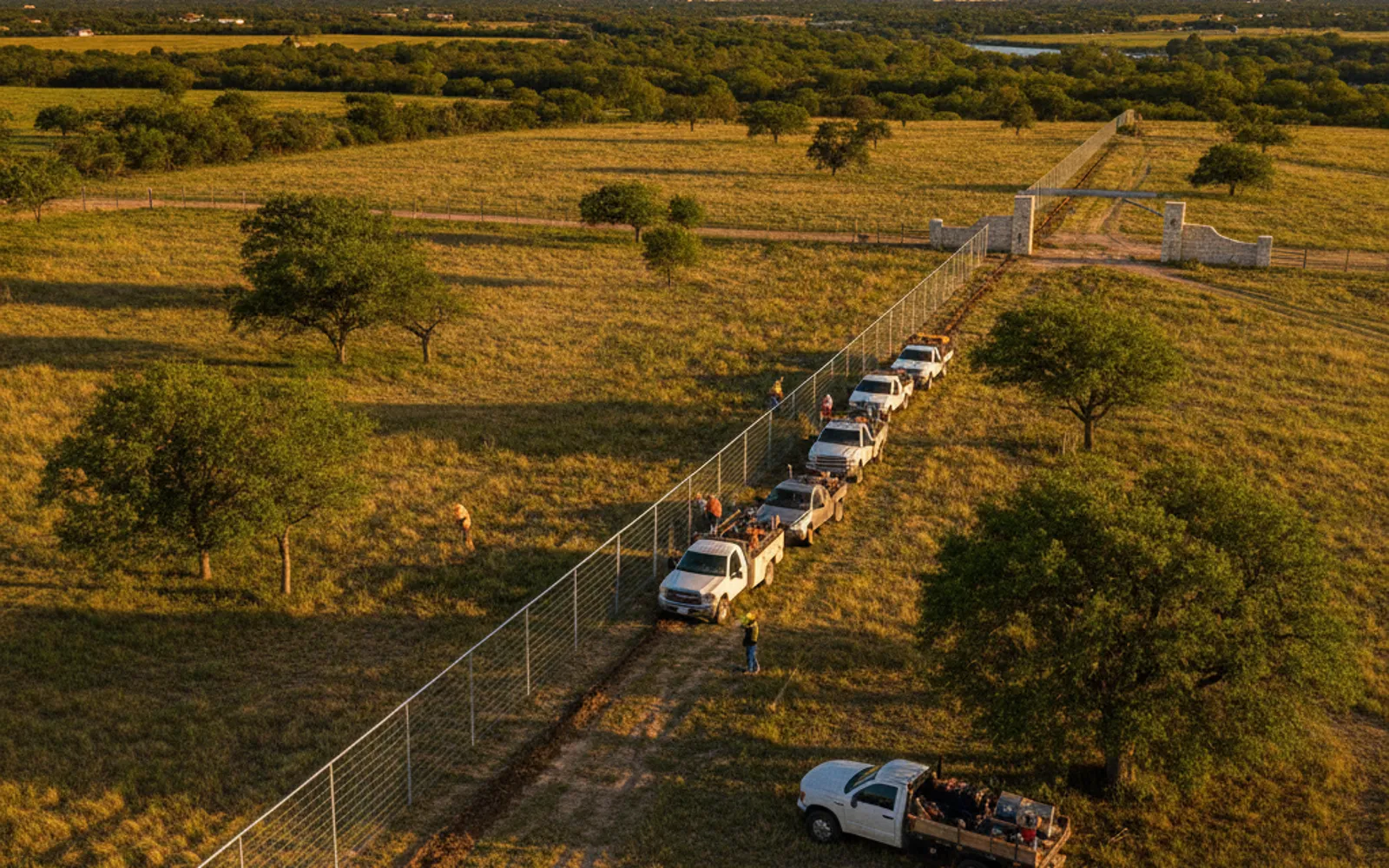
A fence survey is a boundary survey done before you build, so the new fence goes where your deed says your land is and not where an old fence happens to sit. On a perimeter fence along a neighbor, a road or a line nobody has checked in decades, it is usually worth the money. On an interior cross fence well inside your own place, it usually is not.
The reason is arithmetic. A survey is a one-time fee. A perimeter fence is the most expensive thing most small ranches build, and if it goes up in the wrong place, it comes out and goes back up at full price. Posts set in blackland clay or drilled into limestone do not move for free.
If you already have stakes in the ground and want someone to walk the line and price it, call (254) 870-8898 for a free on-site estimate.
When a boundary survey is worth it before you fence
A line in dispute obviously needs a survey. Beyond that, we would get the line surveyed before setting a post when:
- You are replacing an old perimeter fence and nobody knows who built it or why. A lot of old ranch fence went where the dozer could go: around a creek bank, a rock ledge or a cedar line. It may be close to the line. It may be forty feet off.
- Your land was cut out of a bigger place. When a ranch gets split, the new lines between tracts were often never fenced. The only evidence of where they run is a new set of pins and a plat.
- You are building something expensive. Welded pipe fence runs $12 to $28 a foot on our price page, against $2.50 to $5.50 for 5-strand barbed wire. The more a foot of fence costs, the more a foot of mistake costs.
- The run is long. A small angle error at the starting corner keeps growing all the way down the line, and on a run through cedar you cannot see the far end to check it.
- You front a road. A surveyor can show where your deed line meets the highway or county road right of way. Guessing from the edge of the pavement is how fences end up in the bar ditch.
- Land on either side is changing hands. A buyer’s survey will find a misplaced fence eventually. Better you find it before you build.
You can reasonably skip it for a cross fence splitting your own pasture, a trap or horse lot near the barn, or a replacement on a line that was surveyed recently, with the pins still in the ground and matching the old posts.
AgriLife Extension’s A Landowner’s Guide to Fence Law in Texas puts it plainly: without a survey, building a boundary fence is an inaccurate guess.
What a Texas surveyor does (and who is allowed to do it)
Under Chapter 1071 of the Texas Occupations Code, a person may not engage in the practice of professional surveying unless registered, licensed or certified under that chapter, and the law defines that practice to include locating real property boundaries. A registered surveyor carries a seal with their name, registration number and the title “Registered Professional Land Surveyor.” That is the RPLS after the name.
So a fence builder, a title company, an appraisal district map and a phone app are not surveyors. We can pull a string between two pins. We cannot tell you where your line is. Before you hire, check the name on the Texas Board of Professional Engineers and Land Surveyors roster.
What the job usually involves
A boundary survey is mostly research and judgment, with fieldwork in between:
- Records. The surveyor pulls your deed, the neighbors’ deeds and any earlier plats or field notes. Older descriptions sometimes call for a stone mound, a stake or a marked tree.
- Evidence on the ground. The crew searches for existing corners: iron rods, pipes, old stones, fence corners, whatever the records call for.
- Reconciling. When the record and the ground disagree, the surveyor weighs the evidence and decides where the corner is. That judgment is what you are paying for.
- Setting corners. Where a corner is missing, they set a new monument.
- The plat. You get a signed and sealed drawing, usually with field notes, showing the boundary, the corners found and set, and in most cases the fences and improvements they located.
What to ask for when a fence is going in
Tell the surveyor up front that a fence is going on the line. Then ask for:
- Every corner found or set, flagged so you can see it from a distance.
- Line stakes or flagging between corners on long runs, especially where brush blocks the view.
- Existing fences shown on the plat, with how far off the line they sit.
- The plat in your hand before any clearing or post work starts.
On a cedar-choked line, the surveyor may need a sight lane cut before they can run the line at all. Settle who clears what, and in what order, before anyone shows up with a dozer. Our fence line clearing runs $1 to $3 per foot on the service page, and heavy cedar brake can run past that.
The survey fee is set by the surveyor and moves with acreage, corner count, brush and how clean the old records are. A tract with every corner still in the ground is a far smaller job than one rebuilt from 1920s field notes. We do not price surveys, so call two or three RPLS firms, describe the tract, and ask what drives their price.
How to find and read survey pins
Many modern Texas corners are iron rods driven into the ground, often with a plastic or aluminum cap. State surveying rules say that where practical, a monument a surveyor sets at a boundary corner must be marked so it traces back to the surveyor or firm, and set deep and durable enough to stay put (22 Tex. Admin. Code § 138.87). In practice that usually means a cap stamped with a firm name or registration number.
When you go looking:
- Start from the plat. It shows what was found or set at each corner and the distances between them. Walk from a corner you can find toward one you cannot.
- Bring a metal detector. Pins get buried by silt, leaf litter and road grading, and they vanish in tall grass.
- Read the cap and write it down. If it does not match the surveyor on your plat, that is a question for the surveyor.
- A pin is evidence, not a verdict. A rod might be from another survey, another tract, or a mistake. The plat tells you which ones your surveyor relied on.
- Old corners look different. A rock mound, a pipe or a marked tree may be the called-for corner on an old description. Leave it alone.
Do not bury the pin under your corner post
The corner post and H-brace belong beside the pin, not on top of it. Set the post a measured distance inside the line and write that distance down, so the pin stays visible and reachable. Knock a rod out with a skid steer or pour concrete over it, and you may be paying a surveyor to reset it. Our H-brace guide covers how the corner itself should be built.
What an old fence line does and does not prove
Many landowners believe the fence is the line because it always has been. A fence is evidence of where somebody built a fence. A surveyor will note it, and it may help them read how the land has been used. It does not move your deed line by itself.
The AgriLife guide says it is very difficult in Texas to take someone’s land by adverse possession. Where the claim rests on grazing inside a fence, Texas courts sort fences into a “casual fence” and a “designed enclosure.” An old fence that was already there when the claimant took possession, built for reasons nobody can show, is presumed to be a casual fence, and a casual fence generally does not prove adverse possession.
A recent case out of the Waco Court of Appeals shows how that plays out. As summarized on AgriLife’s Texas Agriculture Law blog, in Best v. Thornton the owners’ two tracts were described as 322 and 320 acres, 642 in all. A 2020 survey run from the deed’s metes and bounds came to 599 acres, while a second survey along the old fence found 642 acres under fence. The owners had used the extra 42 acres for grazing cattle and hunting leases for more than 50 years, and still lost their claim to it. The court called the old fence a casual fence, and replacing posts and wire over the years did not change that. The Texas Supreme Court declined to hear the case in August 2024.
Two lessons for anyone about to rebuild an old line:
- Do not assume the old fence is your line, in either direction. It may be handing you land that is not yours, or fencing you out of land that is.
- If you and the neighbor agree to leave a fence off the true line, put it on paper. The same post suggests a recorded boundary line agreement or an affidavit explaining why the fence sits where it does. A real estate attorney can draft it, and it saves the next owners the argument.
Working with the neighbor on a survey
Your corners are also your neighbor’s corners, and some of the evidence may sit on their side. Tell the neighbor before the crew shows up. A call that says “I’m having the line surveyed before I rebuild the fence, the crew may be at the corners Tuesday” heads off most trouble.
- Walk the flagged corners together. People accept a pin they have seen far faster than a drawing.
- Share the plat. It is their line too.
- Keep the fence talk separate. The survey answers where the line is. Who pays and whether the fence sits on the line or inside it are different questions, covered in building a fence on the property line in Texas and who pays for a fence between neighbors in Texas.
- If the survey surprises someone, slow down. If the line puts a barn, a tank or a feeder on the wrong side, stop and talk to a real estate attorney before anyone pulls a post.
Buying land instead? Our checklist on inspecting fences before buying land covers comparing the plat to the fence on the ground.
From survey stakes to a finished fence
Once the corners are flagged, the fence work is like any other build, with more care at the ends. The order that works on most Central Texas tracts:
- Survey and flag the corners. Get the plat in hand.
- Clear the line. Clear your side unless the neighbor has agreed in writing to clearing on theirs. Keep the blade away from the pins and replace any line stakes the clearing knocks out.
- Set corners and braces first, at a measured offset from the pins.
- Pull a string or a single wire between corners. Line posts follow that, not your eye and not the old fence.
- Build the fence. Set line posts, hang wire, stretch and tie off.
The fence costs the same whether it sits on surveyed ground or not. Five-strand barbed wire fence runs $2.50 to $5.50 per foot on our ranch fence cost page. For a quarter mile (1,320 feet), that is $3,300 to $7,260. Build that quarter mile in the wrong place and you pay for it twice, plus the tear-out. That is the number to set beside a surveyor’s fee.
If your line is surveyed, or about to be, we can walk it with you, look at the corners and the brush, and give you a written number before anything gets cleared. Call (254) 870-8898 for a free on-site estimate anywhere in McLennan, Bosque and Falls counties.
Frequently Asked Questions
Do I need a survey to build a fence in Texas?
For an interior cross fence well inside your own land, usually not. For a perimeter fence along a neighbor or a road, it is strongly advisable. A fence does not move a deed line, so if it goes up in the wrong place it may have to come out. AgriLife’s Texas fence law guide calls a boundary fence without a survey an inaccurate guess. A survey before you build is the reliable way to know where the line runs.
Who can do a boundary survey in Texas?
Chapter 1071 of the Texas Occupations Code bars anyone from practicing professional surveying, which includes locating property boundaries, unless they are registered, licensed or certified under that chapter. The survey you rely on should carry the seal of a Registered Professional Land Surveyor (RPLS). Check the name on the state board’s roster before hiring. A fence contractor, title company or appraisal district map cannot tell you where your boundary is.
How do I find my property pins?
Start with your survey plat, which shows what was found or set at each corner and the distances between them. Walk from a corner you can see toward the missing one, and use a metal detector, since rods often end up buried under silt, leaves or grass. Many modern pins are iron rods with a stamped cap. If you cannot find a corner, or the cap does not match your plat, call the surveyor.
Can an old fence become the property line in Texas?
It is hard. AgriLife’s fence law guide says adverse possession is very difficult in Texas. Courts presume an old fence of unknown purpose is a casual fence, which generally does not prove a claim. In a recent Waco Court of Appeals case, owners who had grazed inside an old fence for over 50 years still lost the extra 42 acres. Do not assume the fence is the line; get it surveyed.
How much does a land survey cost in Texas?
It depends on acreage, the number of corners, brush, and how clean the old deed records are, so get quotes from two or three surveyors and ask what drives their price. We do not price surveys. For the fence side of the math, a quarter mile of 5-strand barbed wire runs $3,300 to $7,260 at our published $2.50 to $5.50 per foot, and that is what a misplaced fence costs to build a second time.