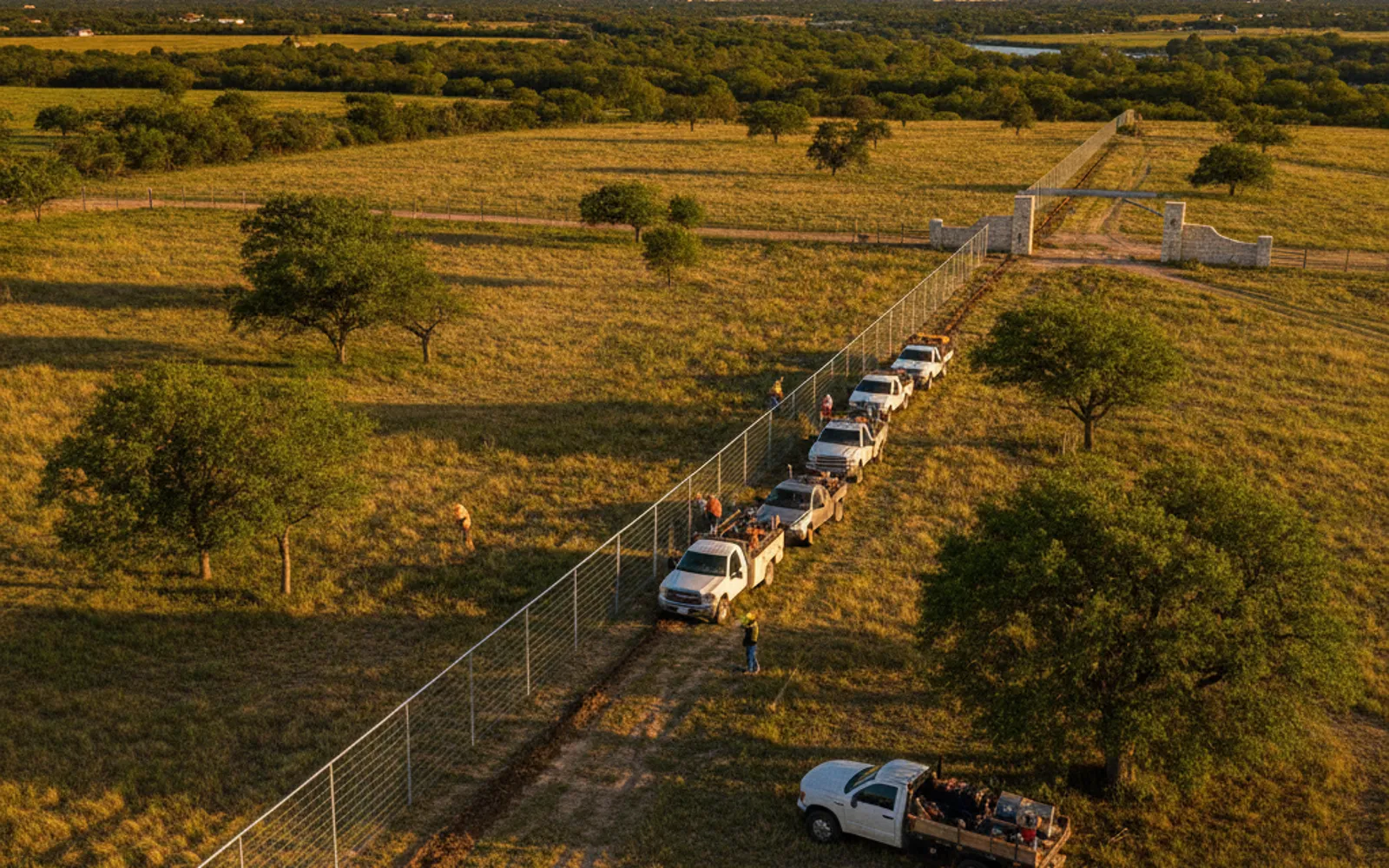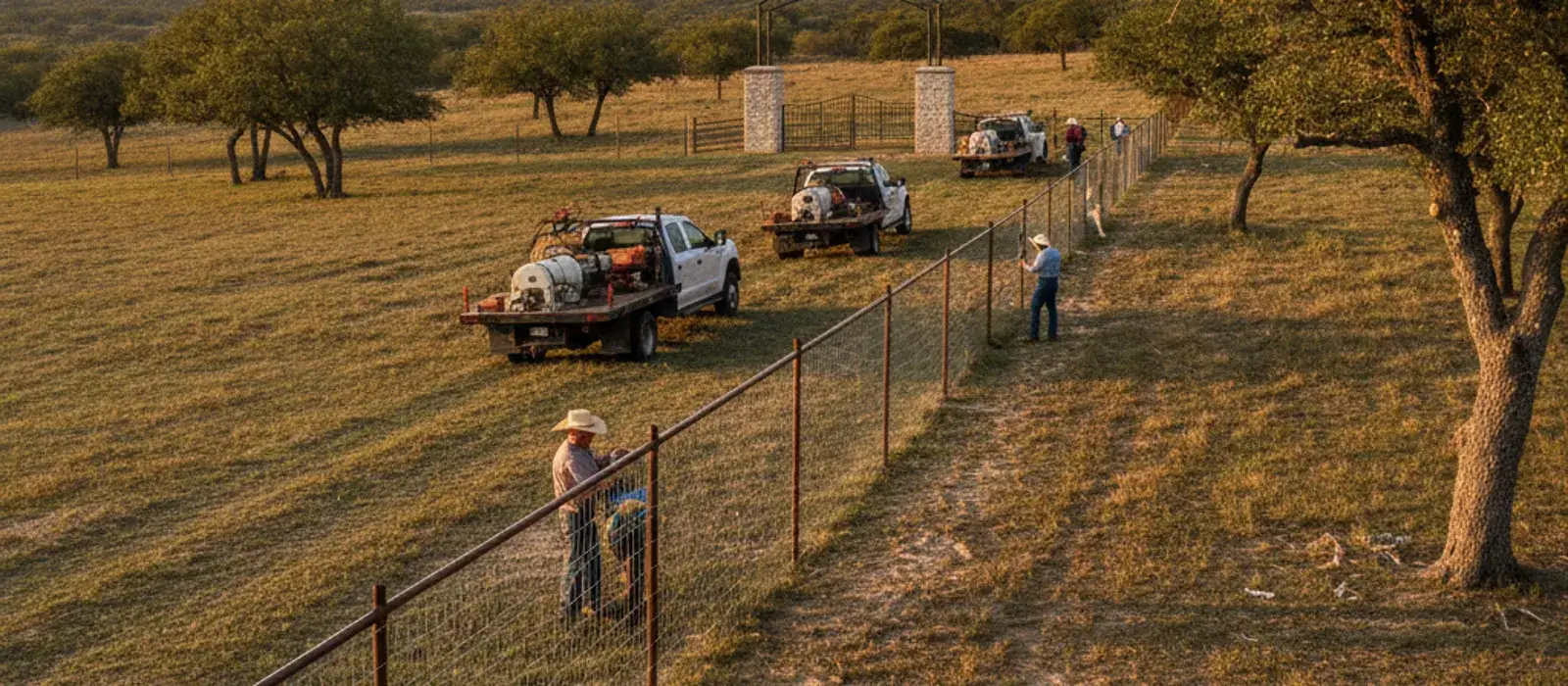
The prettiest 100 acres in McLennan County can hide $40,000 in fence problems behind one nice entrance gate. Most buyers walk the house, kick the barn door, test the well, and never look at the one improvement that runs the entire perimeter of the property.
That’s why you should inspect fences before buying land, every time, before you sign anything. Fence on a working ranch isn’t decoration. It’s infrastructure, and it’s priced like infrastructure. New barbed wire runs $2 to $4 per foot installed around here, and a mile of fence is 5,280 feet. Do that math on a quarter section and you’ll see why a “small fence issue” can swing a deal by five figures.
This guide walks you through exactly what to check, what it costs to fix, and how to use what you find at the negotiating table. It’s the same walk-through we do for buyers all over Central Texas.
Why Fence Condition Should Change Your Offer Price
Sellers and listing agents love the phrase “fenced and cross-fenced.” It sounds complete. It tells you nothing about condition.
A property can be fenced and cross-fenced with 60-year-old rusted wire on rotted cedar posts, and the listing reads exactly the same as a place with five-year-old fence on steel pipe corners. One of those properties is ready for cattle the day you close. The other one needs a six-figure rebuild before you can safely turn out a single cow.
Here’s the frame we give buyers: fence is either an asset or a liability, and it’s never neutral. Good fence adds real value because you don’t have to build it. Bad fence subtracts value twice. You pay to tear it out, then you pay to build new. Removal alone often runs $1 to $2 per foot before the first new post goes in the ground.
There’s a liability side too. In most of Texas, if your cattle get onto a highway and cause a wreck, you can be on the hook if you knew your fence wouldn’t hold them. The Texas Agriculture Code, Chapter 143, covers fencing and stock law rules, and most of McLennan, Bosque, and Falls counties operate under local stock laws that put the burden on the livestock owner. Buying a place with failing perimeter fence means buying that risk on day one.
If you’re under contract on a place right now and the clock is ticking, we can walk it with you. Call Brazos Ridge Fence Co. at (254) 870-8898 and we’ll give you a free written estimate you can take straight into negotiations.
How to Inspect Fences Before Buying Land: The Perimeter Walk
You can’t inspect fence from the truck. Plan to walk or ATV the full perimeter, and budget about an hour per mile if you’re actually looking. Bring gloves, a camera, and something to take notes on. Here’s what to check, in order of what matters most.
Corners and braces first. The corners carry the whole fence. Look for H-braces at every corner and gate: two solid posts, a horizontal rail, and a diagonal wire. If corners are single posts leaning toward the pull of the wire, the fence is failing from the inside out no matter how straight the line looks today. Our post on H-brace fence corners shows what a correct corner looks like.
Grab the posts. Push hard on every tenth line post. A sound post barely moves. A post that wobbles like a loose tooth is rotted at the ground line, and rot rarely hits just one. Kick the base of wood posts and probe at soil level with a screwdriver. Soft, punky wood means the clock’s already run out.
Read the wire. Surface rust is normal on older galvanized wire. Deep rust, flaking, and wire that snaps when you flex it is dead wire. Check tension by pressing down on the top strand between posts. More than a few inches of give means stretching at minimum, replacement more likely.
Walk every water crossing. Creeks and draws are where fences die first. Look for water gaps, the sacrificial fence sections built across drainages. Missing or blown-out water gaps are open doors for your cattle and the neighbor’s.
Check the gates. Swing every gate. Dragging, sagging, or wired-shut gates tell you how the whole place was maintained.
Red Flags That Cost Central Texas Buyers Real Money
We’ve walked a lot of pre-purchase properties around Waco, and the same handful of problems shows up over and over. Three quick stories from folks we’ve worked with show what’s at stake.
The Crawford wire that looked fine from the road. Dale Hutchins was under contract on 160 acres outside Crawford last spring. From the county road, the perimeter looked straight and tight. Walking it, we found about two miles of barbed wire so rusted it snapped by hand, hung on cedar posts from the 1970s. Replacement bid came to $38,000. Dale took our written estimate to the seller and negotiated $18,500 off the purchase price. One afternoon of walking fence paid him more per hour than most people make in a year.
The Valley Mills buyer who skipped the walk. A young couple bought 90 acres near Valley Mills without ever checking the fence, trusting “fenced and cross-fenced” in the listing. Six weeks after closing, their cattle pushed through a rotted stretch and ended up on FM 56 at night. Nobody got hurt, and they were lucky. They ended up spending about $31,000 replacing the worst 1.4 miles of perimeter, money they could have negotiated off the price if they’d found it first. If you’ve ever dealt with cattle getting out of a fence, you know that phone call is the worst one a rancher gets.
The Lorena water gap. Maria Salazar was looking at 45 acres south of Lorena with a creek through the back. The listing photos never showed the creek crossing, and there’s a reason. Both water gaps were gone, washed out years earlier, and the erosion had taken two line posts on each bank with it. That was a $4,800 fix, and she got the seller to cover it at closing because she asked before she signed.
The pattern in all three: the fence problems were findable in an afternoon, and every dollar identified before closing was a dollar of leverage.
What Fence Repairs Actually Cost Around Waco
Numbers make negotiations. Here’s what common fixes and replacements run in our area right now. These are typical installed ranges for McLennan, Bosque, and Falls counties, and your terrain, rock, and brush can move them.
| Problem Found | Typical Fix | Cost Range |
|---|---|---|
| Loose or sagging wire, posts sound | Re-stretch and re-staple | $0.50 to $1.00 per ft |
| Scattered rotted posts | Replace posts, reuse wire | $25 to $45 per post |
| Failed corner or gate brace | Rebuild H-brace | $250 to $450 per corner |
| Blown-out water gap | Rebuild water gap | $800 to $2,500 each |
| Rusted, brittle wire on sound posts | Re-wire 5 strands | $1.50 to $2.50 per ft |
| Full replacement, barbed wire | Tear out and build new | $2.50 to $4.50 per ft |
| Full replacement, net wire | Tear out and build new | $3.50 to $6.00 per ft |
| Old fence removal only | Tear out and haul off | $1.00 to $2.00 per ft |
To put that in acreage terms, a square 100-acre tract has about 5,280 feet of perimeter. Full barbed wire replacement on that tract lands somewhere between $13,000 and $24,000. A square 500-acre place has roughly 2.2 miles of perimeter, and full replacement can clear $50,000 before you touch a single cross fence.
For deeper breakdowns, our ranch fence cost guide covers pricing by fence type, and if the place needs new perimeter wire, our barbed wire fence installation page explains exactly what a properly built fence includes. When you’re deciding whether old wire is worth saving, read rusted barbed wire: repair or replace before you commit either way.
Fence Inspection Before Buying Land: The Legal Questions
The physical walk is half the job. The paperwork is the other half, and it trips up more buyers than bad posts do.
Is the fence on the property line? Old ranch fences wander. Some were built along the easiest ground, not the surveyed line, and some have been “fence line” boundaries for so long that nobody remembers where the deed line runs. Compare the survey to the fence on the ground. If they disagree by more than a few feet, get it resolved in writing before closing, not after. Texas has specific rules on boundary fences, and our post on who pays for a fence between neighbors in Texas covers how shared fences work here.
Who maintains shared fences? Ask the seller directly about any agreements with neighbors, written or handshake. A neighbor who has “always kept up the south fence” may feel differently about a new owner.
Does the fence support the ag exemption? If the property carries an agricultural valuation, the fence has to actually hold livestock for the grazing use to be real. A perimeter that can’t turn a cow can put an ag exemption at risk, and losing one can mean thousands per year in extra property taxes plus rollback exposure. Texas A&M AgriLife Extension publishes solid guidance on ag land management and is worth a read before you buy.
Are there easements through the fence? Pipeline, utility, and access easements often come with gates or gaps that third parties can open. Know where they are and who has keys before you stock the place.
When to Stop Guessing and Bring in a Fence Contractor
You can do the basic walk yourself, and you should. But bring in a professional before closing when any of these are true.
First, the numbers are big. If your walk turns up more than a few hundred feet of questionable fence, you need a real bid, not a guess, because your negotiation is only as strong as the estimate behind it. Second, the terrain is rough. Creek crossings, rock, and heavy cedar change costs fast, and eyeballing them gets expensive. Third, you’re planning a different operation than the seller ran. Fence that held gentle cows won’t necessarily hold goats, horses, or keep feral hogs out, and it definitely won’t hold deer if you’re thinking high fence.
And know your own limits after you buy. Re-stapling loose wire is a fine weekend job. Rebuilding corners, stretching new wire, and setting posts in creek banks is hard, dangerous work where wire under tension can cut you badly. When a repair involves a failed brace, a washed-out crossing, or anything near a road where livestock could get loose, stop and call a pro.
We do free pre-purchase fence walk-throughs and written estimates all over Central Texas, from China Spring to West to McGregor. Reach out here or call (254) 870-8898, and if you ever close on a place and wake up to cattle on the road, that same number is our 24/7 emergency line.
Frequently Asked Questions
How long does it take to inspect the fences on a property?
Plan on about an hour per mile of fence if you’re checking posts, wire, corners, and water crossings properly. A square 100-acre tract has roughly a mile of perimeter, so most small tracts are a half-day job including cross fences. Larger ranches are usually a full day, and it’s worth every hour given what’s at stake.
Can I use fence problems to negotiate the purchase price?
Yes, and it’s one of the most effective negotiation tools rural buyers have. Get a written repair or replacement estimate from a licensed contractor, then present it as a price reduction or a seller-paid repair credit at closing. Sellers respond to documented numbers far better than to “the fence looks rough.”
What’s the biggest fence red flag when buying ranch land?
Failing corners and braces, because everything else hangs on them. Rusted wire on solid corners can sometimes be re-wired affordably, but leaning corners mean the fence’s skeleton is gone and a full rebuild is usually coming. Rotted posts across long stretches are a close second.
Should the seller fix the fence before closing, or should I take a credit?
Take the credit or price reduction in most cases. A seller fixing fence on their way out the door has every reason to do it as cheaply as possible, and you’ll live with the result for decades. With cash in hand you control the materials, the contractor, and the quality of the build.