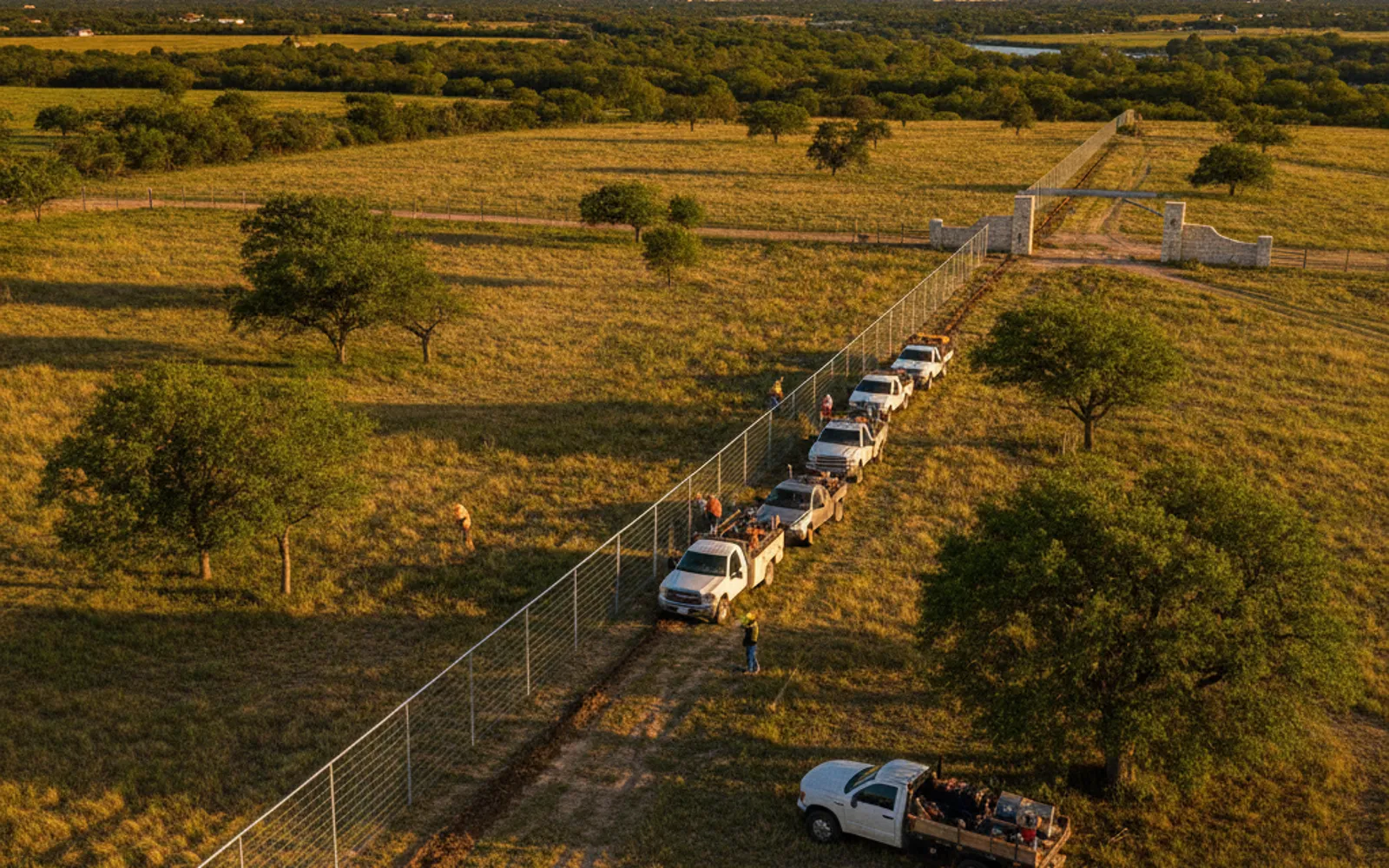
Yes, cattle guards work on cattle. A properly set guard with an open pit, a long enough span and wings that close off both ends will turn a cow herd day in and day out without anybody opening a gate. What a guard does not do is keep working on its own. Most guards that “stopped working” were fine the day they went in. The pit filled with dirt, a wing sagged, or the animals on the other side were never cattle to begin with.
Guards are a good cattle tool and a poor one for horses, goats, sheep and deer. And any guard fails once the pit under the rails is packed full.
If cattle are walking a guard you already have, or you are deciding between a guard and a gate on a new entrance in McLennan, Bosque or Falls County, call (254) 870-8898 and someone will come walk it with you. The estimate is free. For what a new guard costs installed, see our cattle guard cost and installation guide. This article is about whether one will do the job.
Why a cattle guard stops cattle at all
A cattle guard is not a wall. A determined cow could, in theory, pick her way across the rails. Guards work because cattle do not want to try.
Part of that is footing. The rails have open gaps between them, and a round pipe rail gives a hoof nothing flat to land on. A cow that sets a foot down and feels it slide off the curve, or feels nothing under the toe, backs off.
The bigger part is what the cow sees. Temple Grandin’s work on livestock handling notes that cattle, pigs, sheep and horses will often balk at a drain grate, a shadow or a change in flooring, and that an animal’s ability to judge depth at ground level while moving with its head up is probably poor (Behavioral Principles of Livestock Handling). A guard is a big drain grate with a dark hole under it. To a cow walking up the drive it reads as a gap she cannot measure, and most cattle will not commit to it.
That tells you what makes a guard work:
- The open pit. The dark space under the rails is the whole show. Fill it and you have pipes lying on dirt, which cattle will walk.
- Span in the direction of travel. Too long to step across in a stride and too long to hop.
- Sealed ends. If there is any walkable route around the pit, cattle will find it.
- Low motivation on the far side. A cow separated from her calf, or a hungry herd watching the feed truck come in, tests a guard harder than a cow grazing past.
The five ways a cattle guard fails
1. The pit fills in
This is the usual reason a guard that held for years suddenly “quits.” Every rain washes some of the drive into the pit. On blackland clay the fines wash in and set up hard when they dry. On a gravel drive, road base gets bladed toward the guard every time somebody grades. Leaves, cedar litter and flood trash pile in on top.
Nobody notices it happening, because the guard looks the same from the truck. Then one day the cows are across the road. Check it before the cows tell you: push a rod or a tape down between the rails in three or four spots and see how much air is left under the steel. If the bottom is climbing, it is time to clean it.
2. The span is too short
A guard that is only a few feet long in the direction of travel can be jumped, or stepped across by a long-legged animal. Most standard guards run roughly 6 to 8 feet from approach to approach, and a 7 or 8 foot span is what we would set on a working cattle place. Short homemade guards built from salvaged pipe over a narrow trench are the usual offenders.
3. The wings are too short or have gapped out
Wings run from each end of the guard back into the fence line. They have to cover the full length of the pit and tie into a braced post, or a cow will walk the ledge at the end of the guard or squeeze past the last rail. Wings get knocked by trailers swinging in wide, they lean when the post behind them heaves in clay, and feral hogs root under them. A calf only needs a small hole.
Treat the wing tie-in like a fence corner, because it fails the same way. Our post on H-brace fence corners explains why.
4. The rails give the animal a place to stand
Flat-topped rails, or rails set too close together, give a hoof somewhere to land. Cattle that find they can stand on a guard can learn to walk it, and once one cow does it, others follow. Gaps set too wide cause the opposite problem: a calf drops a leg through, and that is how legs get broken. The gap has to be wide enough that the footing feels wrong and narrow enough that a leg does not go through.
5. The wrong animal is on the other side
A guard built around a cow’s hoof and stride will not reliably hold animals built differently.
Horses, goats, sheep and deer
Horses. Most horses respect a guard, and that is the problem: most is not all. A horse’s lower leg and hoof are narrower than a cow’s, and a horse that tries a guard and drops a leg between the rails will often panic and fight it. On a horse place we hang a gate. For fence that suits horses, see our horse fence page and the ranking in safest fence for horses.
Goats and sheep. Small, pointed hooves and a lot of patience. Goats will pick their way across rails that stop cattle cold. If you run small stock near the entrance, a guard is not your containment. A gate and the right goat and sheep fence are.
Deer. A Utah State University report for the Mountain-Plains Consortium states that cattle guards are generally effective at keeping hoofed livestock off highways but largely ineffective as barriers to mule deer. In baited test pens fitted with simulated standard guards about 7 feet long in the direction of travel, mule deer crossed on roughly four out of five approaches (Flower and Cramer, Utah State University). The report lists double guards, two standard guards set end to end, among the designs that can hold deer, at much higher cost. Whitetails are not mule deer and that test was baited, but the lesson for a high-fenced place is the same: do not trust a single guard to hold deer or exotics.
Sizing and load rating, from the “will it work” side
The cost guide covers sizing in detail. The short version:
- Width across the drive is about vehicles. Size it to the widest thing that will ever come through, with room for a trailer swinging in off the road. A trailer tire dropping off the end of a narrow guard is how wings get flattened, and a flattened wing is how cattle get out.
- Span in the direction of travel is about cattle. Long enough that it cannot be stepped or hopped.
- Load rating is about the guard surviving. The ratings borrow highway bridge notation. An H-20 design truck is a two-axle truck of 40,000 pounds (an 8,000 pound front axle and a 32,000 pound rear axle). HS-20 adds a second 32,000 pound axle under a trailer, for 72,000 pounds. If a feed truck or a fire engine will use the entrance, go H-20 at least. If a loaded cattle pot or any other tractor-trailer comes through, that is the truck HS-20 describes, so buy HS-20.
Rating and function are tied together. A guard that has settled at one end or sits on soft backfill bends rails, a bent rail changes the gap, and a changed gap is a spot where a cow can stand or a leg can go through.
Cattle guard vs gate
| Cattle guard | Gate | |
|---|---|---|
| Holds cattle | Yes, while the pit is open and the wings are sound | Yes, when it is shut |
| Holds horses, goats, sheep, deer | Not reliably | Yes, with the right gate |
| Human error | Nobody has to close it | Somebody leaves it open |
| Heavy traffic | Built for it | Slows every trip |
| Upkeep | Pit cleanout, wing and footing checks | Hinges, latches, sag at the hinge post |
| Moving stock on foot | Not across it | The normal way through |
| Installed price | $3,500 to $8,000 for a cattle guard, per our ranch fence cost page | Depends on the gate and posts; see ranch entrance gates |
The strongest setup on most cattle places is both: a guard for daily traffic and a bypass gate beside it. The gate is how you move stock on foot, how a wide implement gets through, and how the entrance stays shut on the day the guard is out for cleaning.
Keeping a guard working
A guard is low-maintenance, not no-maintenance. Two checks a year and one after any big rain catch most of what goes wrong.
Check the pit depth. Probe between the rails at both ends and in the middle. Silt builds from the uphill side first.
Fix the drainage, not just the pit. If the pit is a catch basin for the whole drive, it refills as fast as you clean it. An approach that sheds water to the ditches, or a drain outlet from the low end of the pit on a sloped site, buys years between cleanouts.
Walk the wings from the pasture side. Look for a leaning post, a sagging panel, a hog-rooted gap along the ground, or a trailer strike.
Check the rails and footings. A rail bent out of line, a cracked weld, or a guard that rocks when a truck crosses means the footing has moved, and it will not get better on its own.
When a guard is badly silted, settled or bent, a cleanout is not the whole fix. Resetting it level, rebuilding a wing or repairing a footing is fence repair work, and it pays to look at the whole entrance at once.
Guards on county roads and state highways in Texas
On your private drive, a guard is your call. On a county road, the county controls it. Under Texas Transportation Code Section 251.009, a commissioners court may authorize a cattle guard on a county road and must set written plans and specifications for a standard county guard. Building one that does not match those specifications is a misdemeanor. Section 251.0096 of the same chapter lets a county remove a guard from a county road after giving adjacent landowners at least 90 days’ notice by certified mail. Ask your commissioner’s office for the county’s standard before you build or replace one.
On a state highway, TxDOT’s right of way manual on passes and cattleguards says a guard on an existing highway goes in under a permit approved by the district, and that passes are maintained by the property owner unless the right-of-way conveyance says otherwise. Before you count on the state to clean out a guard at your highway entrance, read your permit or conveyance to see whose job it is.
When to call
If cattle are crossing a guard that used to hold them, start with the pit and the wings. If the guard rocks, the rails are bent, or it was too short from the start, it may need resetting or replacing.
Call (254) 870-8898 for a free on-site estimate. Someone will walk the entrance, check the pit and the wings, and tell you straight whether your guard can be put right or whether a gate is the better fit.
Frequently Asked Questions
Do cattle guards really work on cattle?
Yes. A guard with an open pit, a span of roughly 7 to 8 feet, sound rails and wings that close off both ends will turn cattle reliably. Cattle balk at a gap they cannot judge and at footing that rolls under the hoof. Guards stop working when the pit fills with dirt, a wing gaps out, or the span is short enough to jump.
Can cattle learn to cross a cattle guard?
Some can. Cattle learn to walk guards when the pit has silted up, when flat rails give them a place to stand, or when the ends leave a ledge to step along. Highly motivated animals, such as a cow separated from her calf, test guards harder. Once one animal crosses, others tend to follow, so fix the cause the first time you see it.
Is a cattle guard safe for horses?
Not reliably. Most horses will not try a guard, but a horse that does can drop a leg between the rails and panic, and that is how legs get broken. A horse’s lower leg and hoof are narrower than a cow’s. On a place with horses, hang a gate at the entrance and fence horses away from any existing guard.
Do cattle guards stop goats, sheep or deer?
Not dependably. Goats and sheep have small hooves and will pick their way across rails that stop cattle. A Utah State University report found standard guards largely ineffective against mule deer, with double-length guards among the designs that can hold them, at much higher cost. For small stock, deer or exotics, use a gate.
How do I know if my cattle guard needs cleaning out?
Push a rod or tape measure down between the rails in several spots and measure the air left under the steel. If the bottom is climbing toward the rails, or you see cattle standing on the guard, clean it. Check after heavy rain, since runoff washes silt in fastest. If it keeps refilling, fix how the drive drains toward the guard.