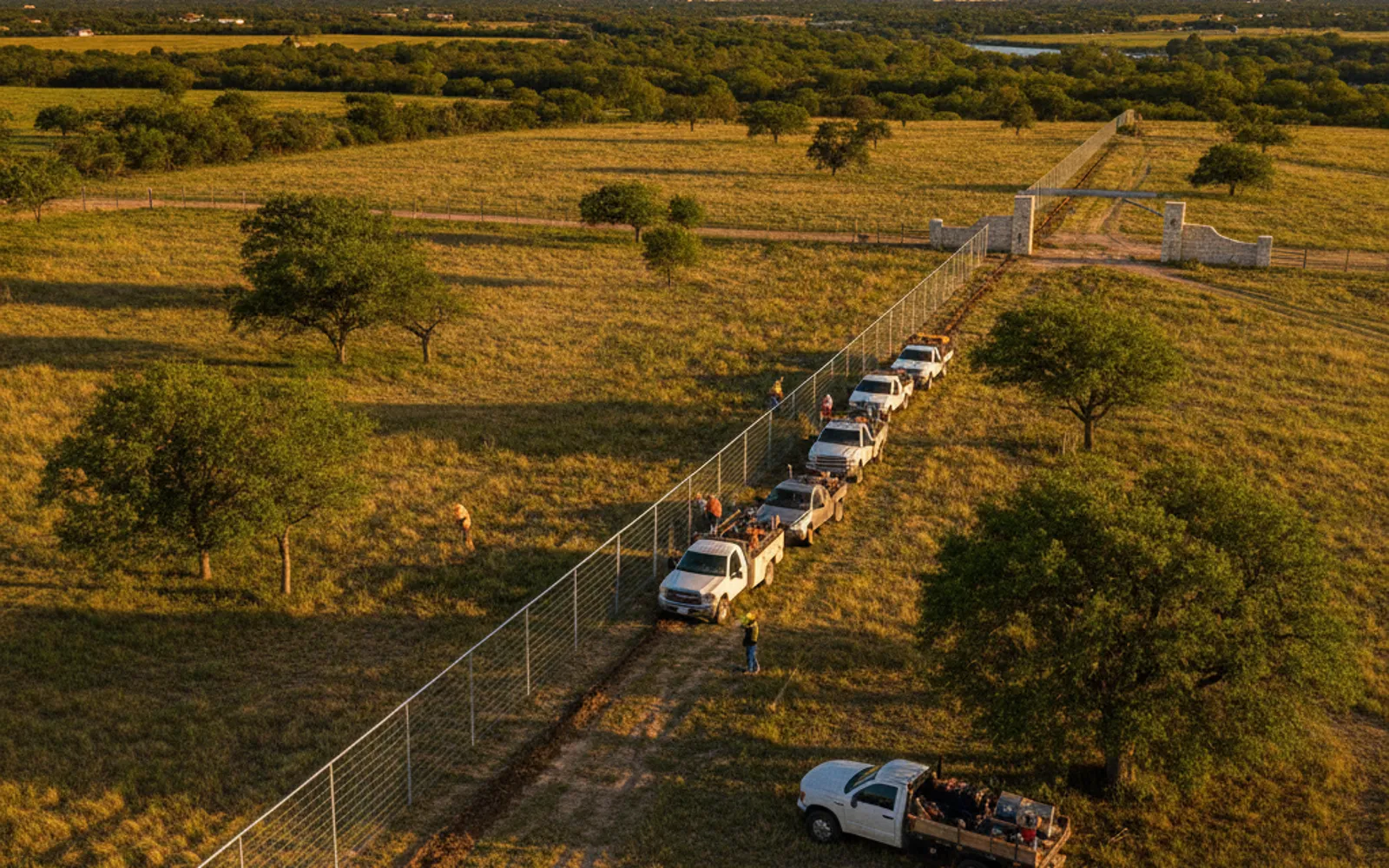
Continuous fence panels are factory-welded sections of round steel tubing, usually 20 feet long with 4 to 6 horizontal rails tied together by vertical uprights. One end of each panel is swaged down so it slides into the next one, and the run gets strapped, clipped or welded to posts set about every 10 feet. Put up right, it looks like one long rail fence with no visible joints.
It is a good fence for horse paddocks, lanes, small pens and frontage on flat or gently rolling ground. It is the wrong fence for a bull pen, a hard working alley, or a pasture that drops through creek draws every few hundred feet. The tubing is much thinner than the oilfield pipe most welded fence around Waco is built from, and that one fact explains most of where it works and where it doesn’t.
If you want continuous fence and welded pipe priced side by side on the same line, call (254) 870-8898 and someone will walk it with you for a free on-site estimate.
What continuous fence actually is
“Continuous” sounds like a technique, but it is a product: a ladder of tube rails with uprights welded through or across them, sold in standard lengths and heights. The swaged end is what makes the run look continuous.
Sioux Steel’s continuous fence line lists 10 and 20 foot panels in 1.5 inch and 2 inch tube, 16 gauge, in heights from 36 to 62 inches with 4 to 6 rails. Their 20 foot, 1.5 inch, 5-rail panel is 48 inches tall and weighs 107 pounds. The 20 foot, 2 inch, 6-rail panel stands 62 inches and weighs 179 pounds. Other brands use different tube sizes, wall thickness and rail spacing, so read the spec sheet for the exact panel you are pricing.
Common sizes you will see
| Spec | Typical range | What it means on the ground |
|---|---|---|
| Panel length | 10 ft or 20 ft | 20 ft is the standard; 10 ft pieces fill short runs and odd corners |
| Rails | 4, 5 or 6 (some 7) | More rails means smaller gaps and more weight per panel |
| Height | About 36 to 62 in | Short panels suit calm stock in small lots; horses want 54 to 60 in, and UT Extension PB1541 puts cattle handling facilities at 60 in minimum |
| Tube size | 1.5 or 2 in on the Sioux Steel line; varies by brand | Bigger tube is stiffer and easier to see |
| Wall | 16 gauge on the Sioux Steel line | About 0.065 in wall, thin next to oilfield pipe |
| Finish | Powder coat, galvanized or bare | Bare steel needs paint within the first season |
Rail gaps follow rail count and panel height, and some panels space the rails tighter at the bottom. Measure the open space between rails on the actual panel. That matters more than most buyers expect, and we come back to it below.
Continuous fence is not the same as a cattle panel
A cattle panel is a sheet of welded rod, usually 16 feet long, stapled or clipped to posts. Continuous fence is tube rail. They fail in different ways, and cattle panels get their own write-up in cattle panel fence vs net wire.
Where continuous fence works
Continuous fence earns its keep in places where animals see the fence up close every day and you want it to look tidy doing it.
Horse paddocks and turnout. Round tube with no sharp ends and no barbs is kind to horses. Height is easy to get right: Penn State Extension’s horse fence planning guide recommends 54 to 60 inches above ground, with about 8 inches of clearance under the bottom rail so a hoof doesn’t get trapped, and no more than 12 inches if you have foals that might roll under. It also wants the open space between rails kept to 12 inches or less. A 62-inch, 6-rail panel, or a 50-inch, 5-rail panel hung with 8 inches of clearance (top at about 58 inches), lands in that range on 10 foot posts. For stallions or horses that lean and crib, add a hot wire along the top.
Lanes between pastures. A lane gets pressure from both sides at walking speed. Continuous fence holds that, and it hangs faster than cutting and welding every rail by hand.
Catch pens and arena perimeters. Cows penned for a few hours, horses tied and saddled, an arena fence that mostly needs to be seen. All fine.
Frontage and around the house. It looks finished from the road for less welding than a full pipe fence. The NRCS Texas fence specification (Code 382) groups pipe and galvanized panel fences together as generally more expensive to install and maintain, and says they are generally used around corrals and homesteads. That matches how it gets used here: close to the barn and the house, not on a mile of back pasture.
Where continuous fence fails
Bulls and working pens
This is the big one. A 16 gauge tube has a wall of about 0.065 inch. The 2-3/8 inch oilfield tubing most Central Texas pipe fence is built from runs around 0.190 inch, roughly three times thicker. A mature bull that pushes, rubs or fights across a fence line loads one panel far past what thin tube was sized for. You see it first as a dented rail or a cracked weld where an upright meets a rail, and after that the panel flexes at that spot every time something leans on it.
The same goes for a crowding tub, a sorting alley or the section beside a squeeze chute, where cattle hit the fence hard and at angles. Build those from heavy pipe. Our corrals and working pens page covers how those get laid out and what they cost.
Rough and broken ground
A 20 foot panel flexes a little to follow gentle roll. It will not follow a creek draw, a terrace or a sharp swale. There you get a gap under the bottom rail, a panel cut and rewelded to step down, or a run of shorter 10 foot pieces. Each costs time, and gaps under the bottom rail are exactly where calves, goats and feral hogs go through.
West of the Brazos and up into Bosque County, the ground is often thin soil over limestone and caliche. The posts still have to go in on a tight spacing, which means drilling rock for a post every 10 feet, where a wire fence can spread its line posts wider. See setting fence posts in rocky ground for what that involves.
Goats, sheep, kids and small stock
Rail gaps that hold a horse or a cow do not hold a goat. If goats, sheep or small calves share the pasture, the panel needs mesh behind it, which starts to erase the reason you picked continuous fence in the first place.
Blackland clay
On the blackland east and south of Waco, shrink-swell clay pushes posts around every wet-to-dry cycle. With wire, a leaning post shows up as a slack strand. With continuous fence, a post that heaves or leans racks the panel and can pull a swaged joint partway open. Post depth and footing matter more on a rigid fence than a flexible one. Setting fence posts in clay soil goes through what holds up.
Posts, spacing and attachment
The panel is only as good as the posts. Most failures blamed on the fence are really post failures.
Post spacing
Plan on posts every 10 feet, which puts one at every panel joint and one at the middle of each 20 foot panel. That is in line with what UGA Extension’s “Fences for Horses” gives for rail fences, 8 to 10 feet between posts. Stretching to 20 feet between posts saves money on paper and gives you a fence that sags in the middle and bends the first time a horse leans on it.
Post choice
- Steel pipe posts. The strongest choice and the one that suits Central Texas best. The NRCS Texas spec, written for wire fences but a fair floor here too, calls for line pipe posts of at least 2-3/8 inch OD set 24 inches deep, Schedule 40 or better, painted or galvanized, with the top permanently capped so rain doesn’t fill the post. Corner and brace posts go at least 3 feet deep. On a panel fence we set corners, gate posts and ends deeper and in concrete.
- Wood posts. Common with continuous fence because the mounting straps lag-screw straight in. Wood works, but it rots at the ground line in our clay and the lag screws loosen as the wood dries and checks.
- T-posts. You will see continuous fence clipped to T-posts for cheap runs. It holds a quiet horse on flat ground. It does not hold anything that pushes, and a T-post leans the moment the ground gets soft after a rain.
Attachment
Ranked by strength: welded to steel posts is strongest, though a damaged panel has to be cut out. U-bolts or saddle clamps on steel posts are easier to repair and a good middle ground. Straps lagged to wood, or clips on T-posts, go up fastest and loosen first. Whatever the method, run a string line along the top rail and check that each swaged end is fully seated before you fasten. A joint left half open works loose on its own.
Paint and rust
Bare panels need primer and paint soon after they go up. Powder coat and galvanizing last longer, but any field weld burns the coating off and needs touch-up. Thin-wall tube has less steel to lose to rust, so an ignored scratch matters more.
Continuous fence vs welded pipe fence
Welded pipe fence here usually means 2-3/8 or 2-7/8 inch oilfield pipe for posts, set in concrete, with pipe or sucker rod rails welded on at every post. Continuous fence swaps the hand-cut rails for factory panels. The posts can be the same.
| Continuous fence | Welded pipe fence | |
|---|---|---|
| Rail material | Thin-wall tube, 1.5 or 2 in at 16 gauge on the Sioux Steel line | 2-3/8 or 2-7/8 in oilfield pipe, or sucker rod |
| Build speed | Faster, fewer field welds | Slower, every rail cut, fit and welded |
| Looks | Uniform, factory straight, clean on frontage | Heavier and more “ranch”, depends on the welder |
| Bull and working pen use | Poor | The right tool |
| Uneven ground | Fair on gentle roll, poor on draws | Every rail cut to fit, so it follows anything |
| Repair | Swap a panel if it’s bolted, cut out if welded | Cut and weld a new rail |
| Small stock | Needs mesh added | Needs mesh or net wire added |
Welded pipe fence in our area runs $12 to $28 per foot, depending on rail count, rock and gates (see the full table on our ranch fence cost page). Continuous fence isn’t a line on that table because the number moves with the panel you pick and the posts under it. The honest way to decide is to price both on your actual line, with the same post spacing and the same gate count, and see what the difference buys you.
A simple way to choose
Say you have 12 acres outside Hewitt with three horses and 600 feet of road frontage. Continuous fence on steel posts suits the paddocks and the frontage. Now say you have 80 acres near Valley Mills with cows, a bull and a set of pens. The pens and anything the bull can reach should be welded pipe, and the back pasture should be wire.
The rule: if an animal will hit that fence at speed or push on it for a living, build it from heavy pipe. If the fence mostly needs to be seen and look good, continuous fence is worth a look.
Getting it priced
Before you buy panels, get the line walked. The things that decide whether continuous fence is the right call (grade changes, rock, what’s in the pasture, where the gates go) are all things you see on foot, not on a map. We build pipe fence and horse fence across McLennan, Bosque and Falls counties, and we will tell you if a cheaper fence does the job.
Call (254) 870-8898 for a free on-site estimate. Someone will walk the line with you and price the options on the same ground.
Frequently Asked Questions
How far apart should posts be for 20 ft continuous fence?
Set posts about every 10 feet, so there is one at each panel joint and one at the middle of every 20 foot panel. UGA Extension gives 8 to 10 feet as the normal post spacing for rail fences. Wider spacing lets the panel sag and bend when an animal leans on it, and it puts all the load on the joints.
Is continuous fence strong enough for cattle?
It holds cows and grown calves in pastures, lanes and holding pens well. It is not built for bulls or for working pens where cattle hit the fence hard, because the tube is thin wall (16 gauge, about 0.065 inch, on one major line). Those areas should be built from heavy welded pipe. See our corrals and working pens page for what that takes.
Is continuous fence safe for horses?
Generally yes. Round tube with no barbs or sharp ends is kind to horses, and 5 or 6-rail panels make it easy to hit the 54 to 60 inch height Penn State Extension recommends. Keep about 8 inches under the bottom rail so hooves don’t get caught, and add a hot wire on top if a horse leans or cribs.
Can I put continuous fence on T-posts?
You can, with clips, and it will hold a quiet horse on flat, firm ground. It will not hold cattle that push, and T-posts lean in wet clay. For a fence you want to last, use steel pipe posts at least 2-3/8 inch OD, capped, and set corners and gate posts deeper in concrete.
Is continuous fence cheaper than pipe fence?
It usually goes up faster because there is less welding, but the total depends on the panel, the posts and the ground. Welded pipe fence around Waco runs $12 to $28 per foot. The fair comparison is both options priced on your own line with the same post spacing, which is what a free on-site estimate gives you.