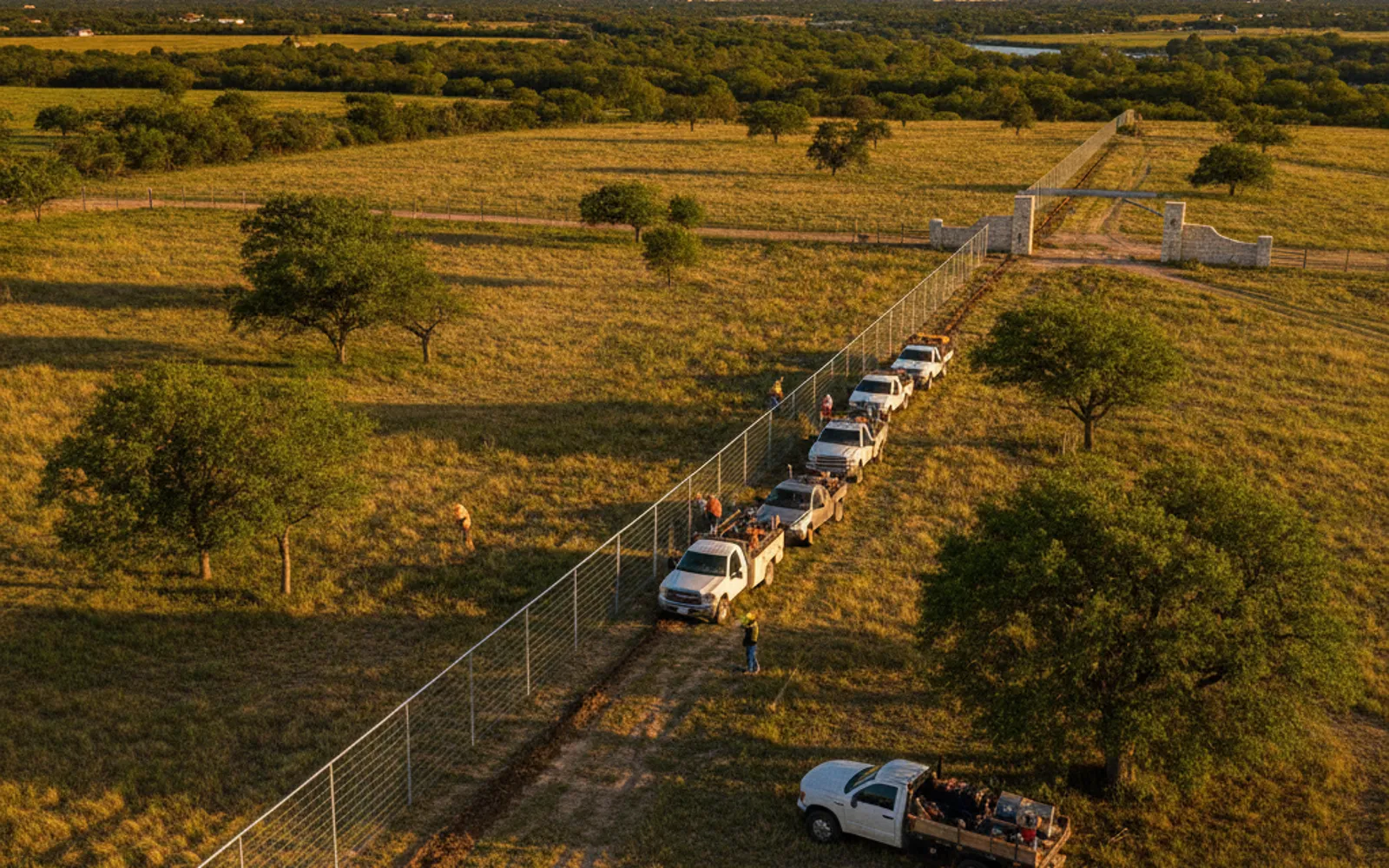
A horse hits a fence at a dead run and the fence either turns him or cuts him. That is the whole question, and it’s why the cheapest horse fencing on most price lists is not fencing you can put a horse behind.
Barbed wire runs $2.50 to $5.50 a foot installed around Waco. It’s the least expensive livestock fence anybody builds here, and it’s the right call for cattle. Put a horse behind it and you have financed a vet bill instead of a fence.
There is a real answer to the cheap question, though. On most small places around McLennan, Bosque and Falls counties, the cheapest fence you can safely keep horses in lands in the $3.50 to $8 per foot range, and the smart moves are about layout and material choice, not about buying the thinnest wire on the rack.
What follows is what each option runs per foot around here, and where the cheap version holds up.
What Cheap Has to Mean When a Horse Is Behind It
Cattle are thick hided and slow to spook. Horses are prey animals with thin skin and a panic reflex, and they run before they look.
A horse fence has three jobs a cattle fence does not. The horse has to see it from a run. A hoof must not fit through it. And nothing on it can cut when 1,100 pounds leans, paws or rolls into it.
Extension programs have been saying this in print for decades. Penn State Extension lists barbed wire as unacceptable for horse fencing in its fence planning guide for horses, and the University of Georgia Extension fences-for-horses bulletin says the same about visibility and hoof-sized openings.
So when we talk about the cheapest option, we mean the cheapest fence that clears those three tests. Go under that line and the money shows up later, usually at the vet.
If you already have horses standing behind old wire and you are trying to work out what it takes to fix it, call (254) 870-8898. Walking the line is free and takes about an hour, and you’ll get a number before anybody talks you into a fence you don’t need.
The Cheapest Horse Fencing Options, Priced Per Foot
Here is the honest spread for Central Texas in 2026. The installed prices are our range for McLennan, Bosque and Falls counties. The electric line is a materials-only general estimate, not a quote, because what it costs to install depends entirely on how much of the old fence stays.
| Fence type | Installed cost per foot | Safe behind horses | Where it fits |
|---|---|---|---|
| 5-strand barbed wire | $2.50 - $5.50 | No | Cattle perimeter only, never a horse pen |
| Plain hinge-joint net wire | $3.50 - $8 | Only with a sight rail on top | Mixed stock, back pastures, low-traffic runs |
| No-climb 2x4 horse mesh | Upper end of the $3.50 - $8 net wire band | Yes | The value pick for horse pasture |
| Electric tape or coated rope | Materials-only estimate, roughly $0.60 to $1.50 per foot of material | As an interior divider, yes; as a sole perimeter, no | Cross-fencing, rotation, temporary paddocks |
| Welded pipe | $12 - $28 | Yes | Road frontage, corrals, high-traffic pens |
Read the table as a spread, not a menu. Almost every horse place we price ends up mixing two of these, and the mix is where the savings live. Full per-foot and per-mile pricing for every fence type sits on the ranch fence cost page.
One thing the table cannot show you is corners. A square 5-acre paddock has far more corners and braces per foot of fence than a long straight run, so short jobs always price higher per foot than big ones. That is not a markup, it is bracing, and it is the main reason a small horse place costs more per foot than a cattle lease.
No-Climb Mesh Is the Cheapest Horse Fence We Will Stand Behind
Two-by-four woven mesh, the stuff most people call no-climb, is the value answer for horses on small acreage in this part of Texas. The openings are too small for a hoof, the wire is smooth, and there isn’t a barb anywhere on it.
It sits at the upper end of our net wire and field fence band, so budget toward the $8 side rather than the $3.50 side. Worth saying plainly: horse-grade mesh isn’t the cheap end of net wire, it’s the expensive end. What you’re paying for is tighter knots, heavier wire and a fence that stays tight when a horse leans on it for ten years.
Two decisions move that number more than anything else. Fixed-knot mesh costs more than hinge joint and holds its shape far better under pressure. And a top rail or a top sight line, whether that is a pipe rail, a wood cap or a strand of coated electric, is what makes the fence visible at dusk.
If the budget is tight, mesh without a top rail is still a safe fence. It’s just a less visible one, and we’d rather add a hot strand on standoffs for pennies a foot than skip the sight line entirely. The material choices are laid out in our no-climb horse fence guide.
Electric Is the Cheapest Horse Fencing on the Board, With Conditions
Coated electric rope or 1.5-inch tape on fiberglass or capped steel posts is the least expensive horse-safe barrier you can put up, and the materials-only estimate above holds for most jobs. It’s visible, it doesn’t cut, and horses learn it fast.
Here is the condition. Electric is a psychological fence, not a physical one. It works because the horse respects it. It quits working the moment the charger fails, the ground rods dry out in an August drought, or a limb shorts the line.
That makes it excellent for cross-fencing and rotation inside a secure perimeter, and a poor choice as the only thing between your horses and a farm-to-market road. If your place fronts a paved road, spend the money on a physical perimeter and use electric inside it.
Grounding is the part most people get wrong here. Blackland clay holds moisture and grounds well most of the year, but the same ground goes to concrete in a dry summer and your fence goes quiet without telling you. Our post on electric fence for horses covers charger sizing, ground rods and the order to troubleshoot in.
Three Central Texas Jobs and What They Run
Numbers land better than adjectives, so here are three situations we price regularly. Treat the totals as worked examples for planning, not as quotes, because the ground under your fence line is the variable nobody can price over the phone.
A 12-acre horse place outside Lorena. Two mares, flat blackland, about 2,900 feet of perimeter with an old four-strand barbed wire fence on it. Pull the wire, keep the good corner posts, run no-climb mesh at 60 inches with a hot strand on standoffs for a sight line. At the upper end of the net wire band that job prices in the low twenty thousands, and the interior cross-fence that splits it into two turnout pastures adds electric rope at materials cost plus a day of labor.
A limestone hill section near Valley Mills. Around 900 feet where every post has to be rock-drilled instead of augered. Same mesh, same wire, same crew, and the price runs to the top of the $3.50 to $8 band because drilling caliche and limestone is slow work with a hydraulic drill. Rock doesn’t change the material list, it changes the hours, and anybody who quotes that line at flat-country prices has not walked it.
A 5-acre place with 300 feet of road frontage near West. Welded pipe across the front at $12 to $28 per foot depending on whether it’s new pipe or used drill stem, then no-climb mesh on the three sides nobody sees from the road. Splitting the job that way costs a fraction of piping the whole perimeter and puts the strongest fence where a loose horse would do the most damage. If pipe is on your list, the pipe fence page has the sizing and the per-foot detail.
Want your own line priced instead of somebody else’s? Call (254) 870-8898 or ask for an on-site estimate and we will walk it with you before any number gets quoted.
Where to Spend First When the Budget Is Tight
If you can’t fence everything this year, fence in this order.
Start with the road side. A horse loose on a county road is the failure that costs the most, and it’s the one section where pipe or heavy mesh pays for itself the first time it holds.
Second, fence the turnout the horses actually live in. A tight, safe 3-acre paddock beats 12 acres of half-good fence every time, and it lets you take the rest of the perimeter in stages next season.
Third, fix the corners and braces before you buy more wire. A fence is only as tight as its H-braces, and mesh stretched against a weak corner will sag inside two summers no matter what you paid per foot.
Last, phase the pretty parts. Entrances, gates and rail fence along the drive can wait. Nothing about them keeps a horse home.
One more piece of arithmetic worth knowing. Fencing the whole perimeter in one go almost always beats doing it in pieces, because mobilization, equipment hauling and material delivery get spread across more feet. If you can wait one season and do it all at once, the per-foot number usually drops. Our page on horse fence in Waco covers how we phase these jobs, and what it costs to fence 10 acres runs the perimeter math for a small tract.
Frequently Asked Questions
What is the cheapest fence that is genuinely safe for horses?
For a permanent perimeter, no-climb 2x4 woven mesh with a visible top line is the cheapest fence that clears all three horse-safety tests. Expect it at the upper end of our $3.50 to $8 per foot net wire range. Electric tape is cheaper per foot on materials, but it belongs inside a physical perimeter rather than replacing one.
Can I just use net wire instead of no-climb mesh to save money?
Sometimes, and it depends on the mesh spacing and the horses. Standard hinge-joint field fence has larger openings toward the top and can trap a hoof or a shoe, and it loosens faster when horses lean on it. If the budget forces plain field fence, add a sight rail or a hot strand at the top and check the fence often.
Does barbed wire ever belong on a horse property?
On the outside of a cattle pasture that horses never enter, yes. Along any fence line a horse can touch, no. Plenty of Central Texas places run barbed wire on the far perimeter and horse-safe mesh around the traps and turnouts, which is a reasonable way to spend a limited budget.
Why did two contractors quote such different prices for the same fence?
Usually rock, brush and bracing. A line that has to be rock-drilled, cleared of cedar, or braced at eight corners costs far more in labor than a clean straight run, and different bids often assume different mesh grades and post spacing. Ask each bidder what wire, what post spacing and how many braces, then compare like for like. A bid that comes in $2 a foot under everybody else is usually missing bracing, not saving you money.