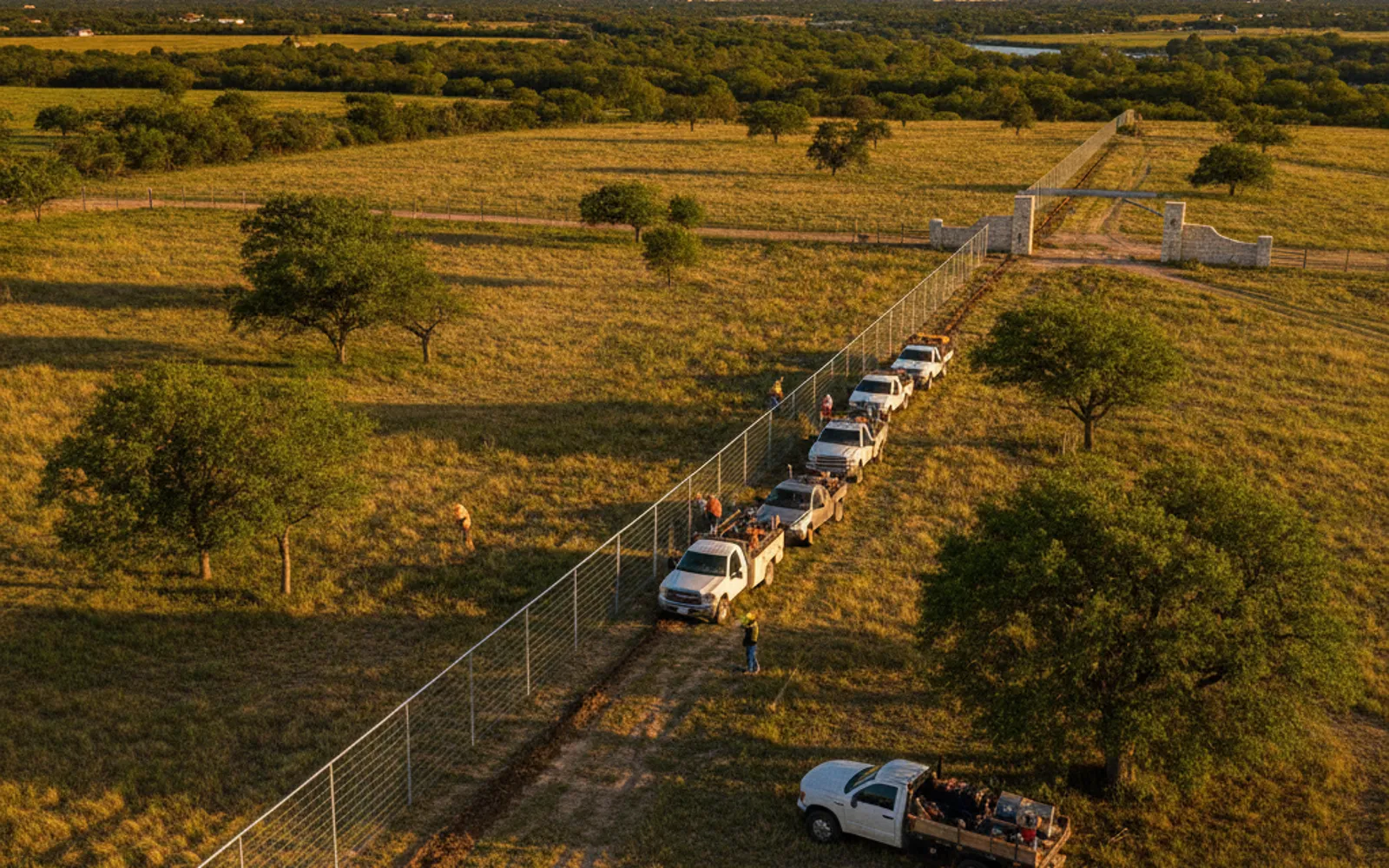
A cable fence is smooth steel cable, usually 3/8 inch, stretched between heavy anchor posts with a spring at one end to soak up the hit when cattle lean or run into it. It is a pen and corral fence, not a pasture fence. A sucker rod fence is different: solid steel rod out of old oil wells, welded between pipe posts as rails. Both cost less steel than an all-pipe rail fence and both will hold cattle, as long as the posts, ends and welds are built for the load.
The short version. Cable on pipe posts suits holding pens, feed areas and alleys where cattle crowd and push, because the cable gives and comes back. Sucker rod works as a top rail over wire, as gate rails, and as tight-spaced rails in calf pens. Welded pipe rail is still the stiffest and easiest to live with, and it is the pick for bull pens and road frontage.
If you want someone to look at your pens and tell you which fits, call (254) 870-8898 for a free on-site estimate. We walk the line before we quote a number.
What a cable fence actually is
The University of Georgia’s Fences for the Farm describes cable fence as 3/8 inch smooth steel cable, normally seven wires twisted together, run from one anchor post to the next, with heavy springs at one end of each cable. On the wooden posts that publication has in mind, the cables usually pass through holes in the posts, and six cables is a common build. The same publication is plain about cost: cable is expensive enough that it mostly gets used for holding pens, feedlots and corrals.
The NRCS Texas fence standard groups cable with pipe, chain link and panel fence as types that are generally more expensive to install and maintain than wire and are used mostly around corrals and homesteads (NRCS Texas Code 382 specification). Around here, cable mostly shows up at pens and feeding areas, rarely on perimeter fence.
Why the spring matters
When a 1,200 pound cow hits a tight cable with no give, the whole load goes into the end posts and clamps. With a heavy spring on one end, the cable gives a few inches, the cow bounces off, and the cable pulls back to line. The spring also takes up the slack that comes and goes with summer heat, cold snaps and cattle rubbing. The other end of each cable is dead-ended hard to its anchor post.
Cable spacing and height
Spacing depends on what the pen holds. For grown cows, a common layout is 5 or 6 cables over roughly 5 feet, closer at the bottom than the top so a calf cannot slip under and a cow cannot get her head between the top two. Oklahoma State’s corral and working facilities fact sheet recommends a 60 inch corral fence with posts at least 30 inches in the ground. The University of Kentucky’s cattle handling facilities guide gives the same 60 inch height for holding pen fence, with posts 8 feet apart and 30 inches deep. Treat those as the floor for cows. Big-framed cattle and bulls call for more height.
Pipe fence with cable: how it goes together
The pipe and cable fence most people picture around Waco is pipe posts, a welded pipe top rail, and cable run below it. The top rail keeps the posts in line and gives cattle something solid to see. The cable does the holding.
Anchor posts carry the whole fence
Every cable pulls on its end posts all the time, and six cables on one corner adds up fast. That is why cable fence fails at the ends first. Anchor posts want to be heavier than line posts (2 7/8 pipe at a minimum, casing on long runs), set deep in concrete and braced. Our write-up on H-brace fence corners covers the principle, and it matters more on cable than on barbed wire. For pipe sizes, see what size pipe for a pipe fence.
Ground matters too. In blackland clay, the soil swells wet and cracks dry, and a shallow anchor post walks toward the pull a little every cycle. On the thin soil over limestone west of the Brazos and in Bosque County, the fight is getting the depth at all, which usually means drilling rock rather than giving up a foot of embedment.
Line posts and how the cable attaches
Line posts on a cable pen are usually 2 3/8 pipe at something close to the Kentucky guide’s 8 foot spacing. Wider spacing works on straight runs with light pressure, but in a crowding area the cable deflects more between posts and cattle learn to push the soft spot.
The cable goes through holes drilled or torched in the posts (cleanest, and cattle cannot pop it off, but deburr the holes or the cable wears through), through short sleeves welded to the post, or it gets tied on with heavy wire, which is the first thing to fail. Any time the cable rides on the face of a post instead of through it, put it on the side the cattle push from, so the post takes the load instead of the attachment.
Clamps and tension
Cable ends are made up with wire rope clips, and one rule is worth knowing: the saddle goes on the live side of the cable, the U-bolt on the short dead end. Backwards, the U-bolt crushes the working cable. Use the number of clips the clip maker calls for on that cable size and check the nuts again after the first time cattle lean on the fence, because new cable settles.
Tension comes from a come-along against the spring, with a turnbuckle or ratchet for fine adjustment. Tight enough that the spring is working, never coiled solid.
Sucker rod as a rail between pipe posts
Sucker rod is the solid steel rod that connects a pumpjack to the pump down in the well. Steel rod comes in 25 or 30 foot lengths and diameters from 5/8 inch up past 1 inch, it is heat-treated carbon or alloy steel, and it has upset, threaded ends. Our used oilfield pipe fence article covers how to tell those products apart and what to check before buying a load.
On a fence, rod does a few jobs well:
- Top rail over barbed or net wire. Welded across pipe line posts, it keeps them in line and stops cattle reaching over the wire.
- Gate and small pen rails. The Kentucky guide gives an example sorting gate of 2 inch pipe with 5/8 inch sucker rods spaced 8 inches apart. Close spacing like that holds calves that would walk through cable.
What sucker rod does badly
Rod is solid but small in diameter, so it bends. A 7/8 rod between pipe posts will hold a cow that leans on it. A bull that hits it hard, or a cow that gets her head through and backs up, can bow it, and a bowed rod stays bowed. A welded pipe rail spreads that load and springs back far better.
The welds are the other weak spot. Sucker rod is heat-treated for fatigue strength in a well, and it does not weld like mild steel. A rod welded cold and cooled fast can crack beside the weld, and those cracks open after a season of rubbing and hard freezes. Many welders who work with rod preheat the joint and let it cool slowly. If you weld your own, bend-test a few practice joints before you build a pen that way.
Watch the ends too. Cut rod leaves square, sharp ends, and untrimmed upset ends stick out past the posts. Horses find every sharp end on a fence. Grind them down or cap them.
Fiberglass sucker rod is a different product
Some sucker rod is fiberglass. On a ranch it shows up as electric fence line posts, because it does not conduct and needs no insulators. The Georgia publication mentions it for that use, and the NRCS Texas spec sets minimum sizes for it: at least 3/8 inch on 1 and 2 wire electric fences, at least 5/8 inch with more wires. It is not a rail material. It will not hold a cow and it does not weld.
Cable, sucker rod and welded pipe rail compared
| Cable on pipe posts | Sucker rod rails | Welded pipe rails | |
|---|---|---|---|
| Best use | Holding pens, feed areas, alleys | Top rail over wire, gates, calf pens | Bull pens, working pens, roadside, horses |
| Under impact | Gives and returns (springs) | Bends and can stay bent | Stiff, spreads load along the rail |
| Weak point | Anchor posts and clamps | Welds and bowed rods | Welds at the posts, if poorly done |
| Upkeep | Check springs and clamps, re-tension | Straighten or replace bent rods | Paint or let it rust, check welds |
| Visibility to stock | Low, add a pipe top rail | Low to medium | High |
Cable is kinder to cattle that crowd into it. At a feed bunk or in a holding pen where cattle lean on the fence all day, a flexing cable is easier on hides and hips than a rigid rail, and it spreads a hit across two anchor posts instead of one weld.
Pipe rail needs no springs, no clamps and no re-tensioning, and cattle and horses can see it. A bull that wants out will test a cable fence by leaning and walking, and a slack cable teaches him that pushing works. For a bull pen, a working alley under pressure, or frontage on a county road, welded pipe rail is the better build. Our pipe fence page covers how we build those runs.
When each one fits your place
Say you run 40 cows outside Crawford and feed in a pen by the barn. Pipe posts with a pipe top rail and five cables under it would suit that pen: the cattle crowd the bunk, the cable takes the pushing, and you can re-tension after a storm without a welder. If the same place needs a bull trap, that wants welded pipe rail, closer posts and more height, because a bull that learns a fence has give will keep working it.
And if you have an old barbed wire fence on pipe posts that wanders between posts, a sucker rod top rail welded across the posts is a sensible upgrade. It stiffens the line and keeps cattle from riding the wire down.
Horse owners should be careful with both. Openings need to be sized so a hoof cannot go through and a head cannot get trapped, and every cut end has to be dressed. Our horse fence page covers what we build for horses.
What it costs and how to get a number
Our cost page has no separate line for cable fence or sucker rod rails. The closest band on our ranch fence cost page is welded pipe fence at $12 to $28 per foot, and a cable or rod build on pipe posts is quoted after we walk it, because the number of cables or rails, post spacing, anchor posts, rock and pen shape all move the price. For a full set of pens, our corrals and working pens page lists general market ranges: $6,000 to $12,000 for a 20 to 30 head setup, and $18,000 to $30,000 and up for 100 head or more.
A cable pen with broken springs, slipped clamps or leaning anchor posts is usually a repair, not a rebuild. Our fence repair page lists what those calls run, including $600 to $1,400 to rebuild a corner or H-brace.
We build pipe fence and pens and repair fence across McLennan, Bosque and Falls counties. Call (254) 870-8898 and someone will walk your pens and fence lines, look at the posts and the ground, and give you a free on-site estimate.
Frequently Asked Questions
What size cable is used for cable fence?
Most cattle cable fence is 3/8 inch smooth steel cable, normally seven wires twisted together, which is the size the University of Georgia’s Fences for the Farm describes. Some builders use heavier used wire rope. Heavier cable holds more, but it also puts more load on the end posts, so the anchor posts and braces have to be sized to match.
Do cable fences need springs?
They should have one on each cable, which is how the University of Georgia describes the build. The spring sits at one end and lets the cable give a few inches when cattle hit it, then pulls it back to line. Without springs, the full hit goes into the end posts and clamps, and they loosen or fail. Check springs every season. One that is coiled flat or rusted solid is no longer doing its job.
Is sucker rod strong enough for a cattle fence?
As a top rail over wire, as gate rails, or as close-spaced rails in a calf pen, yes. As the main rail holding bulls or heavy cattle under pressure, it is marginal. The rod is small in diameter, so a hard hit can bow it, and welds can crack if the rod was welded cold. Welded pipe rail is the safer choice where pressure is high.
Can you weld sucker rod to pipe posts?
Yes, and plenty of Texas pens are built that way, but sucker rod is heat-treated steel that does not weld like mild steel. A weld made cold and cooled quickly can crack next to the bead. Many welders who build with rod preheat the joint and let it cool slowly. Bend-test a few practice joints before committing a whole pen, and grind or cap every cut end.
Is cable fence safe for horses?
It can be, with care. Smooth cable is safer than barbed wire, but it is hard for a horse to see and a leg can go between loose cables. If you use cable around horses, add a pipe top rail, keep the cables tight and closely spaced, and check the ends for sharp clamps. Welded pipe rail or no-climb mesh is the more common horse fence choice.