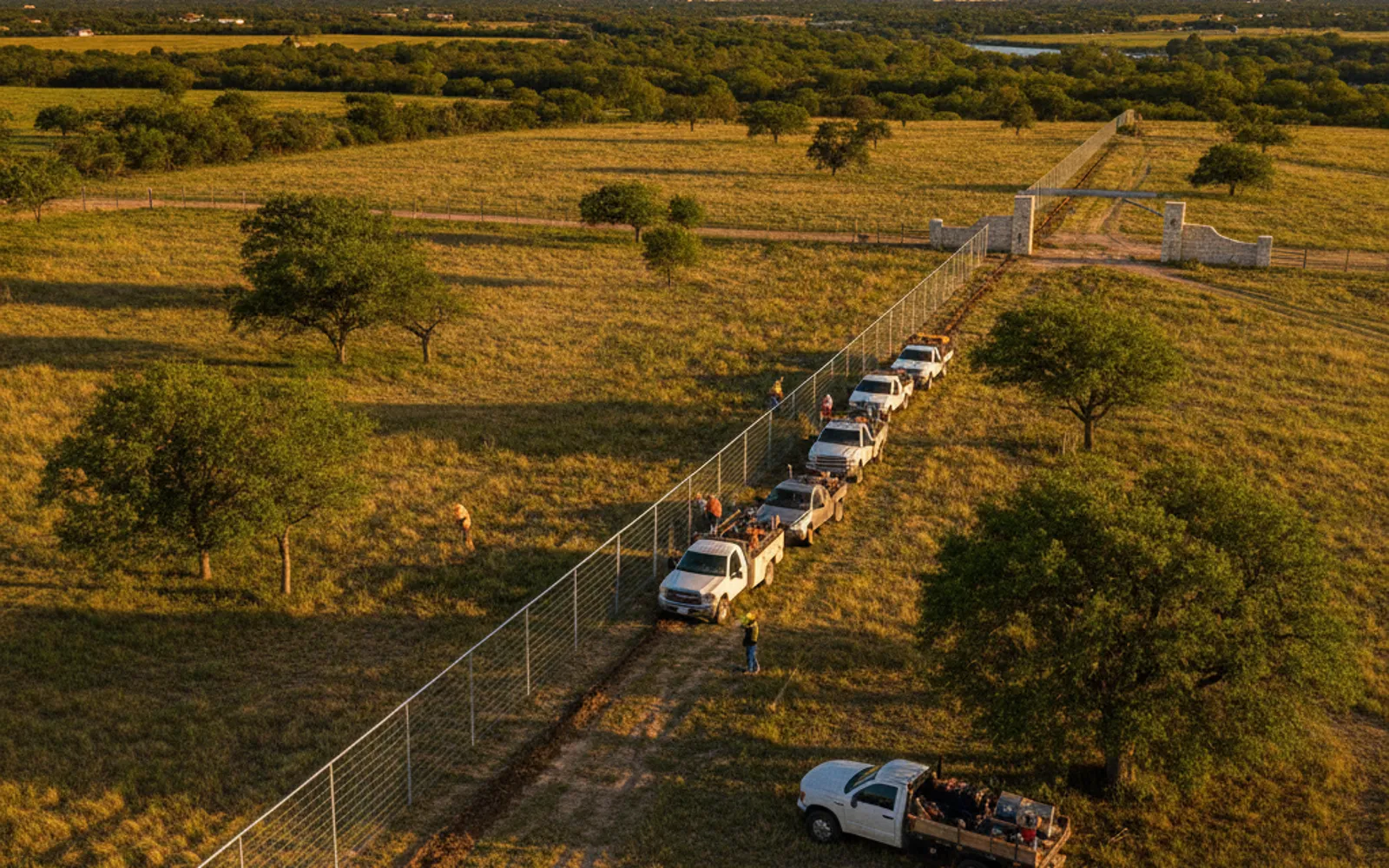
A bull fence has to do three things a cow fence can get away without: stand up to a heavy animal that leans and pushes on purpose, stay tall enough that he is not tempted to go over, and keep him far enough from the cows he wants that he stops trying. In practice that means a taller fence than your pasture fence, heavier posts and braces, and usually an electric wire standing off the fence so he never gets his weight on it. For a pen or trap, it means welded pipe.
The cheap option is genuinely fine in some spots. A calm bull out with his own cows on good grass can live behind tight five-strand barbed wire for years. The trouble starts when cycling cows are on the other side of the wire, yours or the neighbor’s.
If you want someone to walk your line and tell you which stretches will hold a bull and which will not, call (254) 870-8898 for a free on-site estimate anywhere in McLennan, Bosque or Falls counties.
Why bulls beat fences that cows respect
A mature beef bull can easily weigh 1,800 pounds or more, and he does not test a fence the way a cow does. Cows mostly reach through for grass. A bull pushes his head and shoulders into the wire and leans. He rubs on posts. If there is another bull across the fence, the two of them will stand on either side of it and fight, and a fight on a fence line flattens whatever is between them.
Bulls are not jumpers the way deer are, but a bull under pressure will climb, getting his front end up on a sagging top wire or low rail and rolling over. That is why height matters even for an animal that mostly goes through.
The University of Tennessee Extension puts it plainly in Planning and Building Fences on the Farm (PB1541): when bulls are kept apart from cows, the fence needs heavy posts with thick-gauge wire or cables, or electric fence used well. On a light fence it is rarely the wire that gives first. The posts rock loose and the braces creep, and then every wire on the run goes slack at once.
Central Texas ground makes that worse. Blackland clay shrinks in a dry August and swells in a wet spring, so a post tight in April can rock by September. West of the Brazos and into Bosque County, thin soil over limestone means shallow posts unless someone drills rock. A bull finds both.
How tall a bull fence should be
The heights below come from extension and conservation guidelines, and they line up with what works on the ground.
| Where the fence is | Height to aim for | Where the number comes from |
|---|---|---|
| Pasture fence, minimum for cost-share barbed wire | 44 inch average top wire, 4 wires minimum | NRCS Texas Fence Practice 382 |
| Perimeter cattle fence | 54 inches minimum | UT Extension PB1541 |
| Handling facility fences | 60 inches minimum | UT Extension PB1541 |
| Holding pens, British breeds (Angus, Hereford) | About 5 feet | University of Kentucky ID-13 |
| Holding pens, Brahman-cross and exotics | 5 1/2 feet minimum | University of Kentucky ID-13 |
The NRCS Texas fence specification is a minimum for conservation cost-share, not a bull spec. A 44 inch top wire holds a cow herd on good grass, not a bull who wants out.
For a bull pasture, build to at least 54 inches and treat that as a floor. For any pen, trap or alley a bull is going to be worked through, go 60 inches or more. For the Brahman-influenced cattle common around Waco, the University of Kentucky’s Beef Cattle Corrals and Handling Facilities (ID-13) recommends at least 5 1/2 feet for holding pens.
Three builds that hold a bull
Welded pipe fence
Pipe is the most certain answer and the most expensive one. Posts in concrete, a heavy top rail and several rails below it will take a bull leaning on it for years. It is the right call for bull pens, traps, alleys and any short stretch where a bull spends a lot of time, and usually more than a whole pasture needs.
Welded pipe runs $12 to $28 per foot on our ranch fence cost table, and bull work sits toward the upper end because it takes heavier posts, more rails and closer spacing. Post size matters here. For the difference between 2 3/8 and 2 7/8 pipe and where each belongs, see what size pipe for a pipe fence. For how we build it, see welded pipe fence.
Heavy woven wire on stout posts
Good net wire, fixed knot or heavy hinge joint, stretched tight on close-spaced posts with a strand of barbed or a hot wire along the top, holds a bull better than barbed wire alone. The mesh spreads his weight across many wires and stops him getting his head through to lever.
The weak point is height. PB1541 puts most woven wire at 26 to 48 inches tall, so a bull fence needs a strand or rail above the mesh to reach 54 inches or more. Net wire runs $3.50 to $8 per foot, and the net wire fence page covers the rest.
Barbed or high-tensile wire with an offset hot wire
This is often the cheapest real bull fence, because it upgrades a fence you already have. Take a tight five-strand barbed fence and add a smooth electric wire on offset brackets on the bull’s side, at about two-thirds of his height, which is where UT PB1541 puts offset wires. On a big bull that lands near nose height. He touches the hot wire before he ever gets his weight on the barbed wire, and after a few shocks he stops leaning on that fence at all.
It only works while it is hot. The University of Georgia’s Fences for the Farm circular notes that a strand of electrified wire added to other types of fence usually improves them tremendously, and it puts the floor for controlling short-haired cattle at about 700 volts. Treat that number as a bare minimum, not a target. A bull with a reason to leave needs a charger with plenty of reserve, a ground system that still works when blackland clay is dry and cracked, and a line kept clear of grass, cedar and mesquite sprouts that bleed the charge away.
Posts and braces: where bull fences actually fail
Wire gets the blame, but a bull fence fails at the posts and the corners. A few rules that matter more with bulls than with cows:
- Wire goes on the bull’s side of the post. On boundary fences the NRCS Texas spec puts wire on the side of the post facing the animals being controlled. When a bull pushes, he pushes the wire into the post, not off the staples or clips.
- Brace posts go deep. The same spec calls for brace assembly posts buried at least 3 feet unless driven. In blackland clay, deeper is better. In rock, that means drilling.
- Brace at every real change in direction. NRCS calls for a corner brace wherever the line turns 20 degrees or more, and end braces on both sides of every gate. A bull leaning on a gate is testing the gate posts and their braces, not the gate.
- Close up line posts. Pens and bull lots want posts close together. For holding pen fences, the Kentucky corral guide says posts no more than 8 feet apart and at least 2 1/2 feet in the ground.
For how an H-brace carries the load, read H-brace fence corners. A bull will find a lazy brace within a season.
Keeping bulls apart across a fence line
Most bull fence trouble is a bull trying to reach cows, or another bull, on the other side of one fence.
The best fix is distance. If your bulls are penned off the cows, do not put them in the pasture that shares a fence with the cows. If you can, keep one empty pasture or a lane between them. Out of sight and out of smell does more than another row of wire.
When the problem is across a boundary fence, say the neighbor runs a bull on the other side of your cows in breeding season, you have a few options:
- Keep your cycling cows off that boundary during breeding season, if your cross fences let you.
- Run an offset hot wire on your side of the boundary fence so your animals stay off it.
- Build a second fence a few feet inside the boundary so the two herds cannot touch noses. A double fence costs more than an offset wire but it stops fence fighting cold.
Talk to the neighbor before you build anything on or near the line. And if a bull does get out onto a road, who pays is covered in cattle on road liability in Texas.
Bull pens and bull traps
A bull pen is where a bull lives when he is not with the cows. A bull trap is a smaller, stronger pen, often off the working pens, where you catch and hold him to load or doctor. Both want the same thing: welded pipe, tall, with gates that are stronger than you think they need to be.
A few points worth building in from the start:
- Height. 60 inches minimum, and 5 1/2 feet or more on Brahman-cross bulls, per the extension guides above.
- Posts in concrete, rails on the inside. Rails welded on the bull’s side of the posts take the push the same way wire does.
- Gates that close against a stop. Hang each gate so that when it is shut, a bull pushing from inside drives it against a post or a welded stop, not just against the latch. A gate that can swing out under his push is only as strong as its latch.
- Water and shade inside. The Kentucky guide notes that water, shade and feed in a pen let it double as a bull pen. A bull in July sun with no water works the fence harder than one lying in shade.
- A way out for people. Every pen a bull lives in needs a spot where a person can get out quickly without opening a gate.
Here is a hypothetical to put a number on it. Say you want a 60 by 60 foot bull trap. That is 240 feet of fence. At $12 to $28 per foot for welded pipe, the fence alone lands around $2,880 to $6,720 before gates. If the trap is part of a larger working setup, a 20 to 30 head corral runs $6,000 to $12,000 as a general market range. See corrals and working pens for how those are laid out.
Breeding season is when the fence gets tested
A bull that ignored a fence all winter can start working it the week cows start cycling. Walk your bull fences before bulls go in with cows and again before they come out. Look for:
- Posts that rock when you push them, especially in clay after a dry spell.
- Corner and gate braces that have leaned or lifted.
- Sagging top wires or bent top rails.
- Hot wires that are dead, shorted on weeds, or knocked off their insulators.
- Water gaps and low spots where a flash flood left debris or undercut a post.
Fix what you find before turnout. A bull that gets through once will go back to that spot.
Have the bull fence walked before turnout
If your bulls have already found a weak stretch, or you are setting up a new bull pasture or trap, start by having someone walk the line with you and mark what will hold. We build welded pipe, net wire, barbed wire and offset electric across McLennan, Bosque and Falls counties, and we will tell you when an offset wire on the fence you have is enough and when it is not. Call (254) 870-8898 for a free on-site estimate.
Frequently Asked Questions
How tall should a fence be to hold a bull?
For a bull pasture, build to at least 54 inches, which is the University of Tennessee Extension’s minimum for perimeter cattle fence. For pens, traps and alleys, go 60 inches or more. On Brahman-cross bulls, which are common around Waco, the University of Kentucky recommends at least 5 1/2 feet for holding pens.
Will barbed wire hold a bull?
A tight five-strand barbed fence will hold a calm bull that is out with his own cows. It is much less reliable when he can see or smell cycling cows on the other side, or when another bull is across the fence. The usual fix is an offset electric wire on the bull’s side so he never gets his weight on the barbed wire.
Is electric fence enough to hold a bull on its own?
It can be, on interior fences, if the charger is strong, the ground system works in dry clay and the line is kept clean. Most ranchers use electric as an offset on a physical fence instead, because a bull that gets through a dead electric fence once remembers it. On road frontage, build a physical fence first.
What is the best fence for a bull pen?
Welded pipe with posts set in concrete, rails on the bull’s side of the posts, and at least 60 inches of height. Gates should hang on well-braced posts and close against a stop, so the bull’s push lands on steel rather than the latch. Welded pipe runs $12 to $28 per foot, and a pen or trap sits toward the upper end because it takes heavier posts, more rails and closer post spacing.
How do I stop my bull fighting the neighbor’s bull through the fence?
Put distance between them. Keep your bull out of the pasture on that boundary during breeding season if you can, or run an offset hot wire on your side so he stays off the fence. Where they keep meeting, a second fence set a few feet inside the boundary stops nose-to-nose contact. Talk to the neighbor before building near the line.