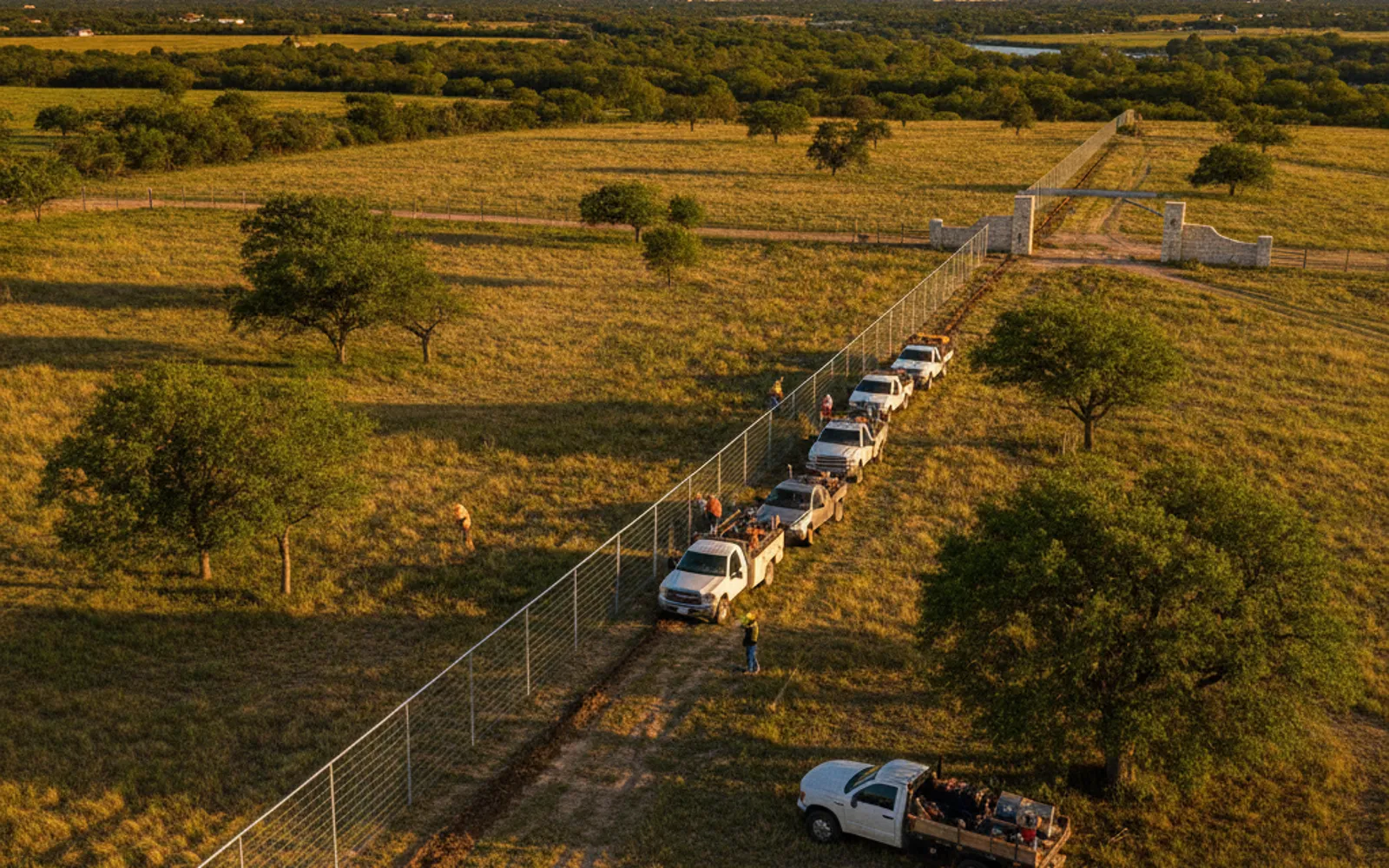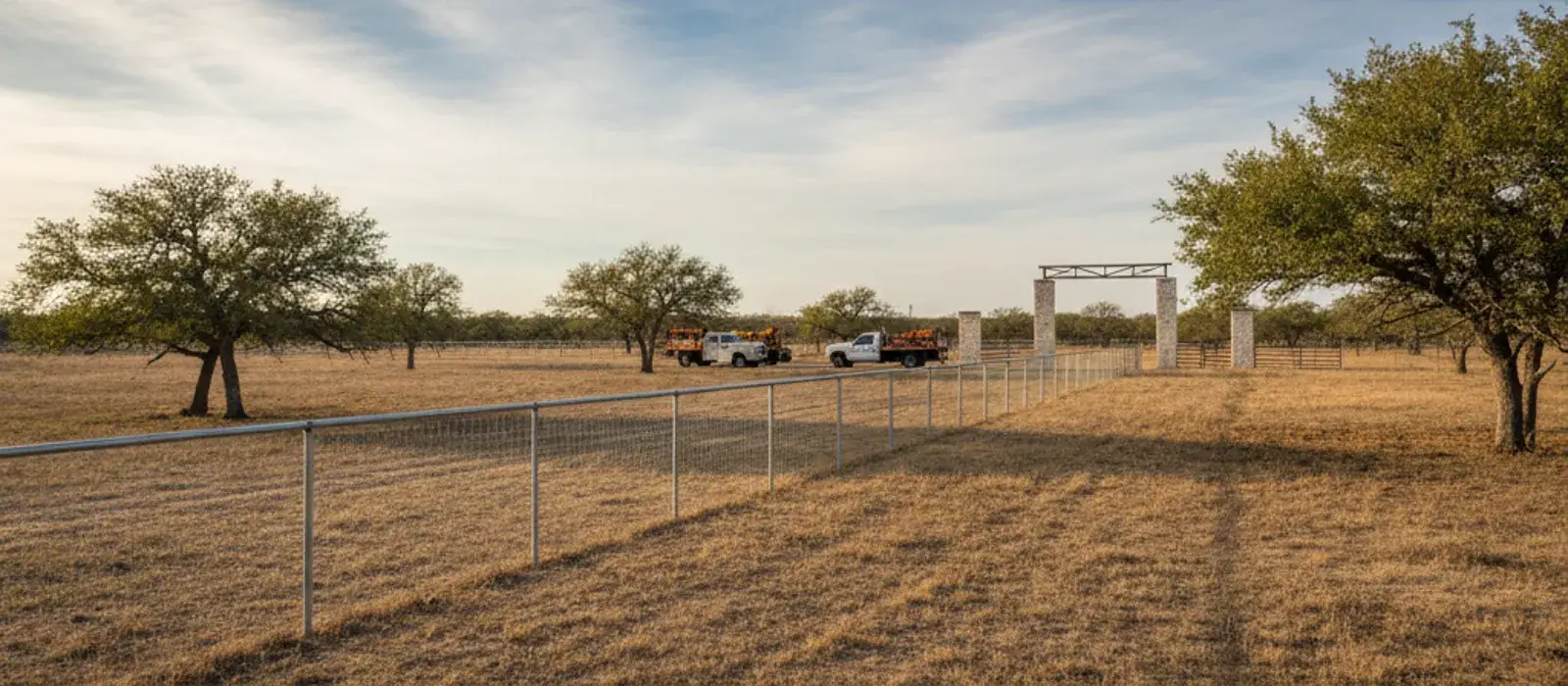
One night of ice in February 2021 tore up more fence in Central Texas than the previous five years of cattle rubbing, hog damage, and rot put together. Here’s the part that still stings: most of the fences that went down that week had weak spots a rancher could’ve found and fixed in one Saturday afternoon.
That’s what winter fence preparation is really about. It’s not some big project. It’s a focused walk of your lines in November or early December, a short list of cheap fixes, and a little chainsaw work before the first Arctic front rolls down I-35. Do it right and an ice storm is an inconvenience. Skip it and you’re chasing cows down a farm-to-market road at 2 a.m. in freezing rain.
We build and repair ranch fence all over McLennan, Bosque, and Falls counties, and every January we see the same failures. Here’s what actually breaks in a Texas freeze, what to check, what fixes cost, and when to call for help.
If you’d rather have a second set of eyes on your lines before winter, we’ll walk them with you. Call (254) 870-8898 and ask for a free written estimate on any repairs we find.
Why a Hard Freeze Hits Central Texas Fences So Hard
Fences up north are built for winter. Ours mostly aren’t, because for eight months of the year the enemy is heat, drought, and hogs. Then a freeze shows up and attacks the fence in three ways at once.
First, ice load. Freezing rain coats every wire, every limb, and every cedar top with a layer of ice that can triple the weight hanging on your fence. A quarter inch of ice adds roughly 500 pounds of weight to a 100-foot span of loaded tree limbs. Wire itself usually holds. The trees above the wire don’t.
Second, soil movement. Most ground around Waco is blackland clay, and clay moves with moisture and temperature. A hard freeze after a wet spell can heave posts upward or tip marginal posts past the point of no return. Posts that were already loose in October end up leaning at 30 degrees by March. If your corners were weak going in, the whole line loses tension. We covered why corners carry the entire fence in our guide to H-brace fence corners.
Third, livestock pressure. Cold cattle bunch along fence lines for windbreak, and hungry cattle lean on wire to reach grass on the other side. A five-strand fence at proper tension shrugs that off. A saggy fence with rusted wire doesn’t, and along a highway, loose cattle can become your liability problem fast.
The National Weather Service office that covers our area keeps winter storm data and safety guidance at weather.gov/fwd. Central Texas averages at least one significant freeze most winters. The question isn’t whether ice is coming. It’s whether your fence is ready.
Your Winter Fence Preparation Checklist
Here’s the walk-through we recommend to every customer, in the order that catches the most problems for the least effort. Budget half a day for a typical 50 to 100 acre place.
Walk every line, don’t drive it. From the truck you’ll see the fence. On foot you’ll see the fence’s problems. Grab every third or fourth post and push. Solid is fine. Wiggle means the post is on borrowed time.
Check tension on every stretch. Barbed wire should feel tight enough to hum when you pluck it. If you can push two strands together easily, that stretch needs restretching before ice and cattle pressure find it. A couple of hours with wire stretchers now beats a blown-out stretch in January.
Test your corners and braces. Push hard on every corner post and gate post. Any movement at all is a red flag, because the corner holds the tension for the entire run. A failed corner in an ice storm can drop a quarter mile of fence at once.
Mark rotted and broken posts. Kick each wood post at ground line. A soft, punky thud means rot. Flag it with tape and replace it before winter, not after. Rotted posts snap under ice load like matchsticks.
Trim the trees. More on this below, because limbs are the number one killer.
Check water gaps and low crossings. Winter rain events blow out water gaps, and a blown gap is an open door for cattle.
Test electric fence now. Cold, wet weather is hard on chargers, connections, and insulators. Walk hot wire lines with a fence tester and fix weak spots before you need them.
Stock a repair kit. Wire, a stretcher, fence pliers, steeples, T-posts, and clips. When the storm hits, the co-op will be sold out.
None of this takes special skills. It takes an honest afternoon and a willingness to fix what you find instead of telling yourself it’ll hold one more season.
Trees and Ice Load: The Fence Killer Nobody Budgets For
Ask any fence builder in Central Texas what wrecks the most fence in an ice storm and you’ll get the same answer: trees. Not wind, not cattle, not the ice on the wire itself. Limbs and whole trees coming down across the top strand.
Roy Slovacek runs about 60 cows off FM 933 north of West. In the January 2024 ice event, a big hackberry limb he’d been meaning to trim for two years came down across his east line and flattened 180 feet of five-strand barbed wire, snapped two wood posts, and let 14 pairs out toward the road. Our crew got there the next morning. The repair ran him $1,850, and he burned a full day of his own time gathering cattle in the sleet. The trimming that would’ve prevented it? About $200 of chainsaw work in November.
Here’s the rule of thumb we give customers: anything hanging over the fence that’s bigger around than your wrist needs to go, and any dead tree within falling distance of the line needs to come down entirely. Live oaks and cedars hold ice worst because they keep their leaves and needles, which gives the ice more surface to grab.
Fall and early winter are the right time for this work. The brush is easier to see through, the ground is firm enough for equipment, and you’re ahead of the storm instead of behind it. If your lines have gone full jungle, we offer line clearing as part of repair jobs.
One safety note we mean sincerely: limbs under ice load and leaning trees store energy like a loaded spring. That kind of chainsaw work hurts people every single winter. Call a professional for anything you can’t drop cleanly from the ground.
Posts, Braces, and What Freezing Clay Does Underground
The damage you can’t see coming is below the ground line. Blackland clay shrinks all summer, cracks open around your posts, then swells shut when fall rain arrives. Add a hard freeze and the moisture in that clay expands, shoving posts upward and sideways. It’s the same reason sidewalks buckle, just slower.
The posts that survive this are the ones set deep, in good soil contact, with sound wood or heavy pipe. The ones that fail were already compromised: shallow-set posts, posts rotted at the ground line, and T-posts driven into loose fill. Some moving posts can be reset, but posts rotted at the ground line need replacing outright.
This is also where pipe fence earns its keep. A properly cemented pipe fence simply doesn’t care about frost heave or ice load the way wood does. We’re not saying replace your perimeter with pipe. We are saying that corners, gate openings, and high-pressure areas like pens and alleys are worth upgrading to pipe, because those are exactly the spots winter attacks first.
Martha Kolar has a horse place outside Valley Mills, and she learned this one the expensive way. A wood gate post on her main entrance had been leaning slightly for a year. The December 2022 freeze heaved it another few inches, the gate dropped and jammed, and then a spooked mare shouldered the whole assembly over. Between resetting the opening with pipe posts and rehanging the gate, she spent $1,400. Resetting that one leaning post the summer before would’ve been about $300.
If you’re not sure whether a wobbly corner will make it through winter, don’t guess. Request a free written estimate and we’ll tell you straight which posts need work and which ones are fine.
Gates, Water Gaps, and Hungry Cattle
Gates fail in freezes for a simple reason: they’re the only part of the fence with moving parts. Hinges seize, latches ice shut, and heaved posts throw the whole gate out of level so it drags or won’t close. Before winter, grease every hinge, check that each gate swings and latches with one hand, and shim or reset anything that’s dragging. A gate that won’t latch is a gate a cow will find.
Water gaps deserve their own line on the checklist. Winter storm systems in Central Texas often bring two or three inches of rain ahead of the cold front, and creeks come up fast. A water gap that’s already half-wrecked from fall rains will wash out completely, and cattle follow creek bottoms like highways. Rebuild weak gaps before winter with breakaway construction so the gap gives instead of the fence. Our water gap fence guide shows the setups that survive Central Texas creeks.
Finally, think about feed placement. Cattle congregate where you feed them, and 30 cows packed against one stretch of fence in an ice storm will test it hard. Feed hay away from fence lines, especially your oldest wire and road frontage. Texas A&M AgriLife Extension publishes solid cold-weather livestock guidance at agrilifeextension.tamu.edu.
What Winter Fence Prep Costs Compared to Storm Repairs
Prevention is cheaper than repair in every trade, but fencing might be the most lopsided example we know. Here’s what the numbers look like on jobs we see every winter.
| Prep task (fall) | Typical prep cost | What it prevents | Typical storm repair cost |
|---|---|---|---|
| Trim limbs over 1/4 mile of fence | $150 to $400 | Limb drop flattening wire and posts | $1,200 to $3,500 |
| Restretch 2 to 3 sagging spans | $200 to $500 | Cattle pushing through slack wire | $800 plus gather time and liability |
| Replace 4 to 6 rotted posts | $240 to $600 | Line collapse under ice load | $1,500 to $4,000 |
| Rebuild one weak corner or H-brace | $250 to $450 | Quarter mile losing all tension | $2,000 to $5,000 |
| Reset and grease gates | $0 to $300 | Jammed or downed gates, escapes | $600 to $1,500 |
| Rebuild a water gap | $250 to $600 | Washout and cattle in the creek | $750 to $1,800 plus lost stock |
Danny Urbanovsky, who runs a stocker operation between Crawford and China Spring, put real numbers on this for us. In fall 2023 he had us do a prep pass on about a mile and a half of older fence: eight posts, one corner rebuild, restretching, and limb work, for right at $2,100. His neighbor across the county road skipped prep that year. The January ice took out roughly 900 feet of the neighbor’s fence in three separate tree strikes, and the rebuild cost him about $6,400. Same storm, same road, one fence bill three times the size of the other.
The pattern holds on nearly every job we quote after a storm. Repairs cost three to five times what prevention would have, before you count lost time and the risk of cattle on a public road. If a storm beats you to it, our storm damaged fence repair guide covers triage and insurance.
When to Put Down the Pliers and Call a Pro
Plenty of winter fence prep is honest DIY work: walking lines, greasing hinges, driving a few T-posts, splicing a break, trimming small limbs. Do all of that yourself and pocket the savings.
But some jobs should end with a phone call, not a trip to the barn for more tools. Call a professional when:
- A tree or heavy limb is down on tensioned wire. Stored energy in stretched barbed wire can whip when it’s cut, and it does real damage to hands and faces.
- A corner or H-brace has failed. Rebuilding one properly takes equipment and know-how, and everything downstream depends on it.
- Posts need to go into frozen or saturated ground. Wrong technique now means redoing it in spring.
- The damage runs hundreds of feet. At that scale you’re not repairing, you’re rebuilding, and it pays to price new construction. Our barbed wire fence crews can usually quote a rebuild within a couple of days.
- Cattle are already out. Get the herd secured first with temporary electric or panels, then fix fence. We run a 24/7 emergency line for exactly this situation.
Winter fence preparation comes down to one idea: find the weak spot before the ice does. Walk your lines in November, spend a few hundred dollars on the obvious fixes, and you’ll spend February by the stove instead of in a ditch with a flashlight in your teeth.
If you’d rather have us handle the walk-through, the trimming, and the repairs in one visit, we do winter prep packages across McLennan, Bosque, and Falls counties every fall. Call (254) 870-8898 for a free written estimate, or reach us here and we’ll get you on the schedule before the first front.
Frequently Asked Questions
When should I start winter fence preparation in Central Texas?
Start in November and aim to finish by early December. Our first real freeze usually lands in late November or December, and ice events cluster in January and February. Starting early leaves time to schedule a contractor for the bigger fixes before everyone’s calling about storm damage at once.
Does barbed wire actually break in a hard freeze?
Cold alone rarely breaks healthy wire, because good galvanized wire handles Texas winter temperatures fine. What breaks fences is weight and impact: iced limbs coming down, trees falling, and cattle pressure on wire that was already slack or rusted. That’s why prep focuses on trees, tension, and posts rather than the wire itself.
Is ice storm fence damage covered by insurance?
Sometimes, depending on your farm and ranch policy. Many policies cover fence damage from falling trees or named storm events, often subject to a deductible and a per-foot or per-structure limit. Photograph everything before you repair, save receipts, and call your agent early, because adjusters get backed up after a big ice event.
What should be in a winter fence repair kit?
Keep a roll of barbed wire, wire stretchers, fence pliers, gloves, steeples, T-posts with clips, and a few insulated splice sleeves in the barn before the first storm. Add a fence tester if you run electric. Supply stores sell out fast after ice hits, so stock up while the shelves are full.