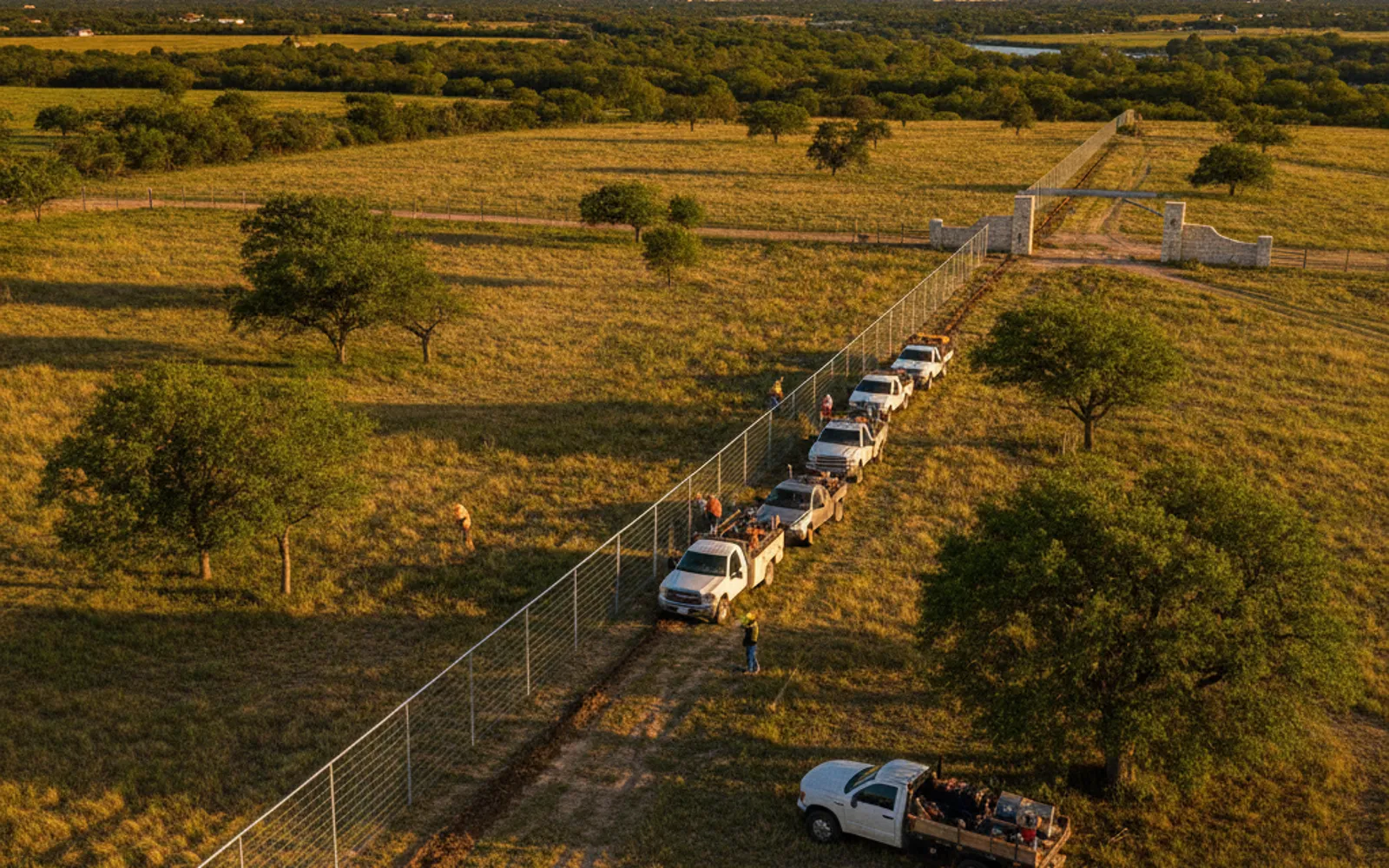
The best ranch entrance ideas start with the truck, not the sign. Before you pick between a pipe arch and limestone columns, settle three numbers: how far the gate sits back from the road, how wide the clear opening is between posts, and how much height you leave under anything overhead. Get those right and almost any style works. Get them wrong and you end up with a handsome entrance your hay hauler refuses to use.
After that it comes down to taste and budget: a pipe arch with a cut-steel ranch sign, stone columns with no overhead, wing fences, and a gate, a cattle guard, or both. Below is each option the way a fence builder looks at it on site, including the parts that fail first.
If you would rather have someone stand at your road frontage and talk it through, call (254) 870-8898 for a free on-site estimate anywhere in McLennan, Bosque or Falls County.
Start with the rig, then pick the look
Every entrance has to pass one test: can your biggest regular visitor get in without backing up on the county road? Around Waco that is usually a gooseneck stock trailer, a flatbed of round bales, or a gravel truck. Design for that rig first.
Setback from the road
Set the gate back far enough that your longest rig can pull completely off the pavement while someone opens it. Measure truck and trailer hitched together and add a few feet. A crew cab with a long gooseneck can run past 50 feet end to end, so a 20 foot setback leaves the trailer sitting in the lane. A gate flush with the road also forces a square turn off a narrow road, which is how gate posts get clipped.
Clear width between posts
Width is measured between the insides of the posts, not the gate length on the tag. Hinges and latch hardware eat into it.
Texas law caps most vehicles on a public highway at 102 inches wide (8.5 feet), under Transportation Code Chapter 621. That sounds like plenty in a 16 foot opening until the trailer tracks inside the truck on an angled turn. Farm equipment is the real width problem: a batwing shredder or tillage tool can be far wider than a trailer. Measure the widest thing you own or hire, then add margin.
Overhead clearance
This is the one people skip, and the most expensive to fix after the concrete sets. The same chapter sets a 14 foot maximum height for a vehicle and its load, and says a driver over 13 feet 6 inches has to make sure the vehicle clears any structure in its path. Your arch is that structure. A hay hauler with a tall load will not come under a low one.
Measure clear height from the finished drive, not bare dirt, because you will add gravel over the years. Allow for the sign too if it hangs below the crossbar.
| Dimension | What we plan around | Why |
|---|---|---|
| Setback from pavement | Length of your longest truck and trailer, plus a few feet | Rig sits fully off the road while the gate opens |
| Clear width between posts | 16 ft minimum; 20 ft or more if equipment or big trailers come through | Trailer tracks inside the truck on the turn |
| Clear height under an arch | 16 ft or more from finished grade | Legal loads run to 14 ft, and the drive rises as you add gravel |
| Post depth | Deeper than line posts, set in concrete | Entrance posts carry gate weight and overhead leverage |
Those are our planning numbers, not a code requirement. For no height limit at all, skip the overhead.
Ranch entrance ideas by style
The welded pipe arch
The standard Central Texas entrance is two tall pipe uprights, a crossbar or arched header, and a sign hung from it. It matches pipe fence, shrugs off a bumped trailer, and can be painted or left to weather. What to get right:
- Upright size. Wind pushes on the sign and the gate hangs off the same post. Use heavier pipe than the line fence.
- Depth. In blackland clay the soil shrinks in drought and swells when it rains, and a shallow post walks out of plumb. West of the Brazos and in Bosque County you often hit limestone within a few feet, which means drilling the rock, not stopping short of it.
- Header shape. A curved arch looks more finished than a straight bar, but check clearance where a trailer actually passes, not at the peak.
Limestone or ledgestone columns
Stone columns are the usual step up from a pipe arch. Native limestone fits the country and never needs paint. The catch is weight: a heavy block on clay that moves needs a real footing and a steel core to carry the gate hinges. A column on a thin slab is how you get the leaning, cracked entrances along older county roads. Two ways to do it:
- Columns with no overhead. Ranch name on a plaque or cut-steel panel on the column face. No height limit, nothing up high for wind to work on.
- Columns with a steel header. The showpiece version, and it carries both costs: masonry and overhead steel.
Overhead ranch sign on tall posts
If what you want is the name over the drive, an overhead ranch entrance sign on two tall uprights gives you that without stonework. It is often the right answer on land being fenced for the first time, where the money is better spent on the perimeter.
Wood and timber entrances
Big cedar or treated timber uprights with a log header suit some properties. Wood in the ground is the weak point: the rot that takes line posts at the ground line takes entrance posts too, and they carry more load. Read our notes on cedar vs treated pine posts before you pick the wood.
The plain working entrance
Not every place needs a sign. A heavy pipe H-frame, a good gate and a cattle guard beside it does the job on a working cattle place, and every dollar not spent on a header goes into fence.
Wing fences: the part that makes it look finished
An entrance standing alone in a pasture looks like an afterthought. Wing fences are the short runs that angle from the entrance posts toward the road or along the frontage. They give a turning truck a clear line on the approach and tie the entrance into the frontage so it reads as one build.
Match the wings to the entrance, not the pasture: pipe wings on a pipe arch, then transition to barbed wire or net wire where they meet the line fence. On a high game fence property, the wings and the entrance have to hold to the same height as the rest of the perimeter or you have built a deer gap into your nicest piece of fence.
Curved wings look good and help the turn. Straight angled wings are simpler and cheaper. Either way, keep them out of the road right-of-way.
Gate, cattle guard, or both
- Gate only. Holds anything, including horses, goats and sheep. Someone gets out every time, and someday someone leaves it open.
- Cattle guard only. Drive straight through. Works for cattle, not reliably for small stock, and cleaning out the pit is part of the deal. An installed cattle guard runs $3,500 to $8,000; sizing and load rating are covered in our cattle guard cost and installation guide.
- Both, side by side. Guard for daily traffic, gate for moving stock, oversize loads, or shutting the place tight. The most practical working setup, and it needs a wider frontage.
If you want the gate to open itself, an operator added to an entrance runs $2,500 to $6,000. Plan for it even if you buy it later: size the posts and hinges for an operator and leave a spot for a solar panel.
Ranch sign ideas that last
Cut steel. Plasma-cut plate with the ranch name, a brand, or cattle or deer silhouettes. Cut-out letters let wind through. A solid panel overhead acts like a sail every time a norther comes through.
Finish. Bare steel rusted to a brown patina needs no upkeep. Paint or powder coat only lasts if the steel is cleaned and prepped first.
Readability. Bold, simple lettering. Thin script disappears at road distance. Judge it from where a driver first sees it.
Mounting. Welded tabs or heavy shackles and chain, not light wire. A swinging sign wears through its hangers, so check them every year.
Drainage, culverts and permits at the road
State highways. A new or changed driveway onto a state highway needs a TxDOT permit before any work in the right-of-way. The TxDOT Access Management Manual says the application goes to the local district office on Form 1058, and no construction in the right-of-way can start until the permit is in hand.
County roads. Most rural drives cross a bar ditch, which means a culvert. In McLennan County a precinct foreman looks at the site and sizes the pipe, and the county then quotes a price and installs the driveway culvert once you pay. You can install your own, but it needs the county’s permit and inspection, and a pipe that is undersized or set wrong can be ordered out and redone at your expense. Bosque and Falls counties set their own rules, so call the county before you pour anything near the ditch.
Water. On blackland a low entrance turns to mud after heavy rain, and a gate across a draw catches brush in a flash flood. Keep the entrance high, crown the drive, and keep columns and wings out of the ditch flow.
What drives the cost of an entrance
A custom ranch entrance runs $5,000 to $25,000 and up. Where a given design lands in that range depends on:
- Overhead or not. An arch adds tall uprights, a header, the sign and more post depth.
- Stone. Masonry columns add footings, stone and a mason’s time.
- Width. Wider openings mean heavier gates, heavier posts and more hinge hardware.
- Ground. Rock drilling in Bosque County and western McLennan costs more than augering clay, and clay needs deeper footings to stay plumb.
- Wings and frontage. Every foot of wing fence and matching frontage fence is priced like fence.
- Automation and a cattle guard. Each is its own line item, priced above.
For the detailed breakdown of gate types, automation and custom iron, see our ranch entrance gate cost guide, and for the per-foot fence numbers on wings and frontage see ranch fence cost.
Walk the frontage before you pick a picture
Photos are good for finding a style. They cannot tell you if it fits your road, your ditch and your rig. That takes standing at the frontage with a tape: where the pavement edge is, where the ditch runs, how much room the trailer needs, and what the ground is (clay or rock).
We build ranch entrances and gates across McLennan, Bosque and Falls counties, from a plain pipe H-frame with a cattle guard to stone columns with a cut-steel arch. Call (254) 870-8898 and someone will walk the entrance with you and give you a free on-site estimate, with options at more than one price point so you can see where the money goes.
Frequently Asked Questions
How tall should a ranch entrance arch be?
Plan on at least 16 feet of clear height from the finished drive surface. Texas caps most vehicle loads at 14 feet, and a driver over 13 feet 6 inches is responsible for clearing any structure in the way, so a tall hay load will not risk a low arch. You also lose height every time you add gravel. If you want no limit at all, use columns with no overhead.
How wide should a ranch entrance be?
Go 16 feet of clear opening at minimum, measured between the posts, and 20 feet or more if equipment, big goosenecks or hay trucks come through. Texas caps most vehicles on the highway at 102 inches wide, but the trailer cuts inside the truck on a turn, and farm implements can be much wider. Measure your widest rig and the angle it turns in at before you set posts.
How far back from the road should a ranch gate be?
Far enough that your longest truck and trailer can pull completely off the pavement while the gate is opened. Measure the rig hitched together and add a few feet. On a state highway the driveway also needs a TxDOT permit before any work in the right-of-way, and on a county road the county usually has a say in the culvert under the drive (McLennan County sizes them and will install them for a fee).
What is the best material for a metal ranch sign?
Plate steel cut on a plasma table is the common choice. Open, cut-out lettering lets wind through, which matters on an overhead sign. Left bare it rusts to a brown patina that needs no upkeep. Paint or powder coat gives color but only holds up if the steel is properly cleaned first. Hang it with welded tabs or heavy chain, not wire.
Should my ranch entrance have a gate or a cattle guard?
On a cattle place, a cattle guard with a gate beside it is the most practical setup: drive through daily, close the gate when moving stock or when you need the place shut tight. A cattle guard alone does not hold goats, sheep or horses reliably, so small stock or horse properties usually need a gate. See our cattle guard guide for sizing and ratings.