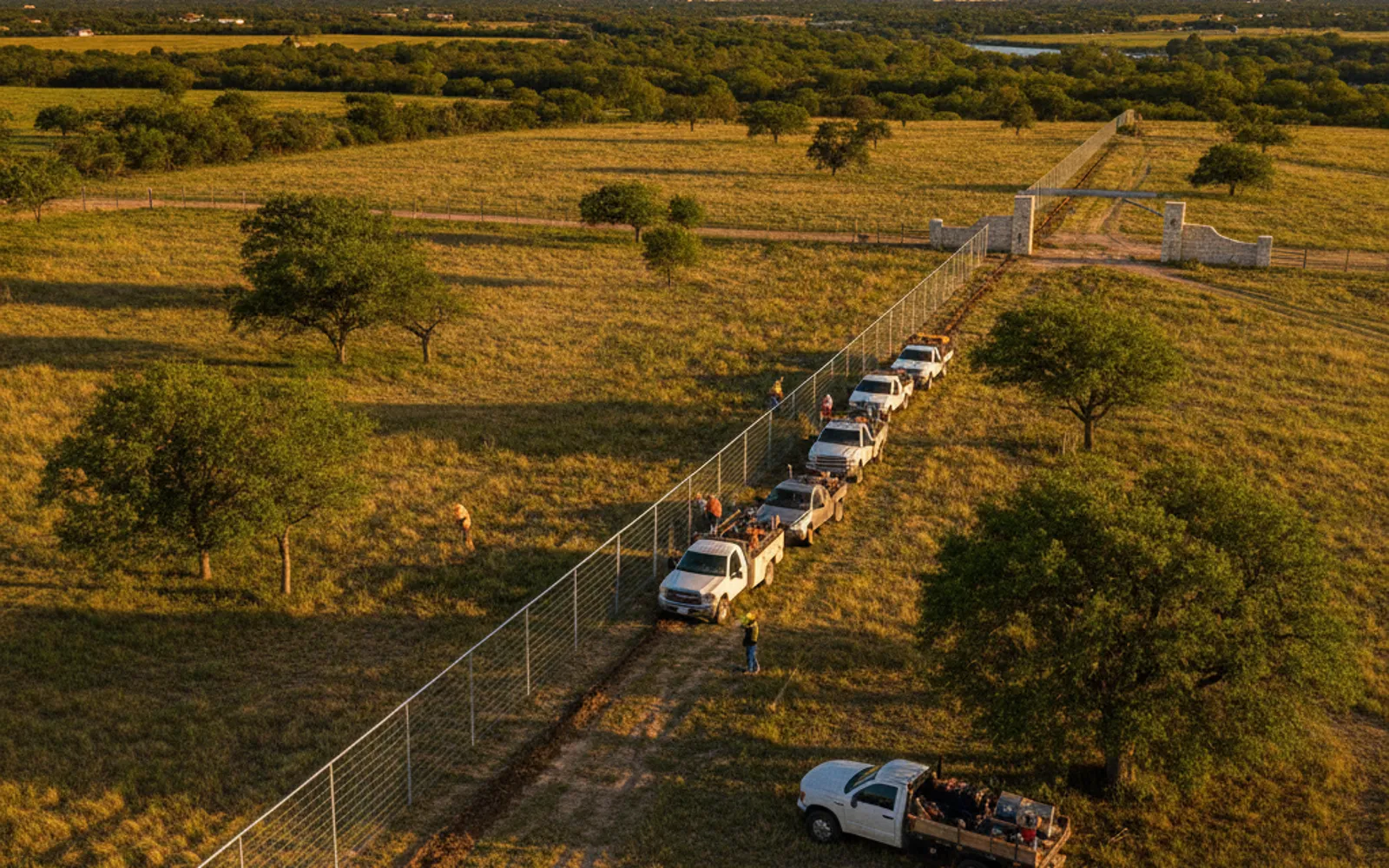
Forestry mulching is the right tool for most fence lanes in Central Texas cedar. A mulcher grinds standing brush and small trees into chips where they stand, kills Ashe juniper outright when it takes the tree to the ground, and leaves a lane you can drive a post into the same week. It is the wrong tool on heavy rock, on old wire buried in the brush, and on mesquite you expect to stay dead.
A dozer, a skid steer with a brush cutter, a hand crew and a brush hog each leave the ground in a different condition, and the fence has to live on that ground for twenty years. Below is what each leaves, which brush comes back, and what “cleared” should mean before posts go in.
If you already know the line needs clearing, call (254) 870-8898 and have someone walk it for a free on-site estimate. We clear across McLennan, Bosque and Falls counties, with or without a fence job attached.
What forestry mulching actually is
The Texas A&M Forest Service separates two jobs people lump together. Shredding is cutting standing grass and weeds down to a few inches with a rotary cutter, the brush hog most of us own. Mulching uses heavier machinery to cut, break and shred woody vegetation into small pieces and spread it over the site.
A forestry mulcher is a spinning drum or disc with fixed or swinging teeth on a skid steer, track loader or dedicated carrier. It chews a cedar down to the ground and the chips fall where the tree stood. What that leaves on a fence lane is a mat of chips, stumps taken to about ground level, topsoil still in place with no berms or pushed dirt, and roots still in the ground. The roots matter a great deal for mesquite and not at all for Ashe juniper.
The Forest Service also lists the limits: large rocks, steep slopes and very wet ground are poor places for machine mulching. West of the Brazos and through Bosque County, where limestone sits at or near the surface, rock changes the method and the price.
The five ways to clear a fence lane
Forestry mulcher
Best on cedar thickets, mixed brush and small trees where the ground is not solid ledge. It is the fastest way to open a closed-in fence row without leaving debris piles. The weak spot is metal. An old barbed wire fence swallowed by cedar will wrap around a mulcher drum, so the old wire has to come out first.
Dozer
A dozer pushes trees over roots and all, and a root rake or grubbing attachment pulls stumps. It handles big mesquite, rock and trees too large for a mulcher, and it leaves disturbed ground: pushed dirt along the edges, loose soil where root balls came out, and brush in windrows that have to be burned, left or hauled. It is the right call when the roots have to come out and the wrong one when you want the topsoil and grass to stay put.
Skid steer with a brush cutter or grubber
A rotary brush cutter on a skid steer is lighter than a mulcher. It cuts and throws pieces rather than grinding them fine, and a grubber or shear attachment can pull or snip single trees. On a lane that was cleared once and has grown back, this is often all the machine the job needs.
Hand crew with chainsaws
Saws go where machines cannot: steep draws, creek banks, beside a sound fence you want to keep, around a tree you want to leave. It is slow, and every tree cut has to be dragged and stacked. For short runs or ground too rough for a carrier, a saw crew still makes sense.
Tractor and brush hog (shredding)
A brush hog keeps a lane open. It does not open one. A rotary cutter is built for grass, weeds and light brush within its rated stem size, and the Forest Service describes shredding as cutting herbaceous vegetation to a height of two to four inches. Run one over young mesquite and you have trimmed it. Its real job is the years after clearing: a pass or two a year down a mulched or dozed lane keeps it from closing in again.
Mulcher vs dozer vs brush hog: what each leaves behind
| Method | Handles | Leaves on the lane | Brush disposal | Fits best |
|---|---|---|---|---|
| Forestry mulcher | Cedar, mixed brush, small to mid trees | Chip mat, stumps near grade, roots in ground | None, chips stay | Cedar lanes on workable ground |
| Dozer (blade, rake, grubber) | Big trees, mesquite, rock | Disturbed soil, pushed edges, roots removed | Windrows to burn or haul | Heavy mesquite, big timber, rock |
| Skid steer brush cutter | Regrowth, small brush | Coarse debris, low stumps | Usually left | Re-opening a lane |
| Hand crew | Anything, slowly | Stumps at saw height unless cut low | Stack, burn or haul | Rough ground, keeping good fence |
| Brush hog | Grass, weeds, light brush | A few inches of stubble | None | Keeping a cleared lane open |
Cedar dies, mesquite comes back
This part decides if you pay for clearing once or three times.
Ashe juniper, the cedar across most of our service area, does not resprout from a cut stump. A paper on juniper control and management on the Texas A&M Natural Resources Server puts it plainly: Ashe junipers of any size can be killed by cutting at or slightly above the soil surface. A mulcher that takes a cedar to the ground has killed it. What comes back later comes from seed, and a brush hog handles those seedlings while they are small.
The exception is redberry juniper, mostly a tree of the Rolling Plains and the Edwards Plateau, west of us. It has a bud zone at the base of the trunk and sprouts back after the top is removed. Ashe juniper carries dark blue berries; redberry, as the name says, carries reddish ones. If you are not sure which you have, find out before you pay to clear it.
Mesquite is the opposite of Ashe juniper. It has buds at and below the ground line, so mulching, shredding or sawing it off only top-kills it. The stump sends up a ring of new stems, and the single trunk you cut becomes a multi-stemmed bush that is harder to kill. Huisache behaves the same way. There are three ways to handle it on a fence lane:
- Grub it out. A dozer or grubbing attachment pulls the root crown below the bud zone. This is the most permanent mechanical option and the one that disturbs the most ground.
- Treat the stump. Cut or mulch it, then treat the fresh stump with a herbicide labelled for that use, following the label.
- Spray the regrowth later. AgriLife’s Brush Busters guide to mesquite says that after mesquite has been top-killed by fire, cutting or any mechanical method, you should wait two full growing seasons before using its leaf spray method. The same sheet covers a stem spray for young, smooth-barked mesquite, applied from the ground line to 12 inches up the trunk.
The same sheet warns that mesquite control is not a one-time job, because livestock and wildlife keep spreading the seed.
What “cleared” should mean before posts go in
A lane that looks open from the truck is not always ready for a fence.
Width. For a new build we clear a working lane of about 10 to 15 feet: room to run a post driver, stretch wire and get a trailer of materials alongside the line. For 8-foot game fence, clear the overhead too. A limb over the top wire comes down on it in the first ice storm, and a fallen limb is a ramp over the fence.
Stumps off the post line. A stump left a foot high in the middle of the line means a post goes somewhere it should not, or a crew goes back with a saw. Stumps on the line itself should be at or near grade.
No buried wire, no brush piles on the line. Old wire hides under cedar for decades and has to come out before a mulcher runs. Windrows pushed against the new line become hog cover and fire fuel, so pile brush well back.
Firm ground where posts go. Where a dozer has pushed dirt or pulled big root balls, the post line is loose fill. Posts in loose fill lean the first wet season, and in blackland clay they lean worse. Let it settle through a rain or two, compact it, or set the line on firm ground beside the disturbed strip. Mulched lanes rarely have this problem.
The line flagged first. The machine operator follows flags. If the flags are wrong, the lane is wrong, and on a boundary fence that becomes your neighbor’s problem too. Our post on clearing a fence line covers the property line and right-of-way side of this.
A plan to keep it open. A brush hog once or twice a year is cheap compared with paying for full clearing again.
Rock, clay and timing in our three counties
On the blackland east of the Brazos, toward West and Marlin, soil is deep and machines work well until it rains. Wet blackland ruts badly under a dozer or track loader, and those ruts dry into hard ridges on the post line. Clear when the ground will carry the machine.
West of the river, toward Valley Mills, Meridian and Clifton, the problem is thin soil over limestone. A mulcher works on much of it, but not on surface ledge. That country is also where posts get drilled instead of driven, covered in our post on setting fence posts in rocky ground.
Season matters for one more reason. Mature Ashe juniper mixed with oaks, especially on slopes and in draws, can be golden-cheeked warbler nesting habitat. TPWD’s golden-cheeked warbler fact sheet lists the bird as endangered, says it returns to Texas in early to mid-March and leaves between late June and mid-August, and names Meridian State Park as a place to see it. A lane through young regrowth is not the same as clearing old cedar-oak woodland, but if your line runs through tall, old cedar mixed with hardwoods in a canyon, clear it in fall or winter and talk to a wildlife biologist before taking out more than a lane.
What clearing costs, and how it compares per acre
Fence line clearing runs $1 to $3 per foot, roughly $5,300 to $15,800 a mile, and heavy cedar brake can run past that. It is always priced as its own line on a fence estimate, never folded into the per-foot fence price, because it varies more than any other part of the job. The rest of the fence prices are on our ranch fence cost page.
Say you have a half mile of line outside Meridian grown shut with cedar. That is 2,640 feet, so at $1 to $3 a foot the clearing is $2,640 to $7,920, more if it is a closed brake on a rocky slope.
If you have been pricing land clearing by the acre: a 12-foot lane one mile long covers 12 x 5,280 = 63,360 square feet, about 1.45 acres. At $5,280 to $15,840 for that mile, that is roughly $3,600 to $10,900 per acre. Per-acre bids for open pasture are not a fair comparison, because a lane is a long, narrow strip that has to be finished to a standard posts can go into.
Getting your line cleared and built
The useful first step is having someone walk the line. Species, stump size, rock and old wire set the method and the price, and none of that shows up in a photo. Once the lane is open, it can go straight into a barbed wire or net wire build without a second mobilization.
Call (254) 870-8898 for a free on-site estimate on fence line clearing, on its own or as part of a new fence, anywhere in McLennan, Bosque and Falls counties.
Frequently Asked Questions
Is forestry mulching better than using a dozer?
For most cedar fence lanes, yes. A mulcher kills Ashe juniper when it takes it to the ground, keeps the topsoil in place, and leaves no brush piles. A dozer is better where the roots must come out (mainly heavy mesquite), where trees are too large for a mulcher head, or where rock rules out mulching. The ground a dozer leaves usually needs to settle before posts go in.
Will cedar grow back after mulching?
Ashe juniper does not resprout from a stump cut at or near the ground, so a mulched cedar is a dead cedar. New cedar comes back from seed over the years, and a brush hog handles those seedlings while they are small. Redberry juniper, found mostly in the Rolling Plains and on the Edwards Plateau, is different: it sprouts from a bud zone at the base and needs that zone removed.
Can I clear a fence line with a brush hog?
Only light brush and grass. A rotary cutter is built for herbaceous growth and small stems within its rating, and it only top-kills mesquite. On a line that is already open, a pass or two a year is the cheapest way to keep it open. On a line grown shut with cedar, it is the wrong machine.
How wide should a fence line be cleared?
About 10 to 15 feet for a new fence. That leaves room for a post driver, a wire stretcher and a trailer alongside the line, and it lets you drive the fence afterward to check it. For 8-foot game fence, also clear overhanging limbs above the top wire, since ice storms bring them down onto the fence.
How much does forestry mulching cost per acre?
We price fence line clearing by the foot, at $1 to $3 per foot. For a 12-foot lane, one mile is about 1.45 acres, which works out to roughly $3,600 to $10,900 per acre of lane. Per-acre bids for clearing open pasture are priced differently, so they do not compare directly with a fence lane. Heavy cedar brake can run past the top of the range.